






After a twelve-year hiatus, Evil Empire delivers a fantastic vampire hunt. This classic 2D adventure shines with top-notch controls, but ultimately feels a bit tame.
It’s been a while since I’ve reviewed a new Castlevania game. The last time I did so was in 2014, and it wasn’t an exceptionally positive experience. In that sense, no matter what happens from here on out, I’m very glad that one of my all-time favorite series didn’t end 12 years ago. Instead, regardless of what else Castlevania has in store, Castlevania: Belmont’s Curse has at least brought the series’ longest hiatus to a close with a real highlight.
I had relatively little doubt that it would turn out at least okay—after all, the actual developer, Evil Empire, not only had Konami’s support and thus access to the Castlevania legacy, but as an indirect part of Motion Twin, they’d already tinkered extensively with *Dead Cells* and put together the quite decent *The Rogue Prince of Persia* for Ubisoft. They’ve got the 2D Metroidvania expertise—now the question was how much Castlevania is in *Belmont’s Curse*, how much *Dead Cells*, and whether the mix works.
Well, the mix works, because anyone expecting a Dead Cells with a Castlevania look will be disappointed. Castlevania: Belmont’s Curse is a classic Metroidvania, very much in the style of its predecessor, Symphony of the Night, and its Game Boy and DS spin-offs. No roguelike elements here—just a large, interconnected playground, strict 2D gameplay, and plenty of Castlevania.
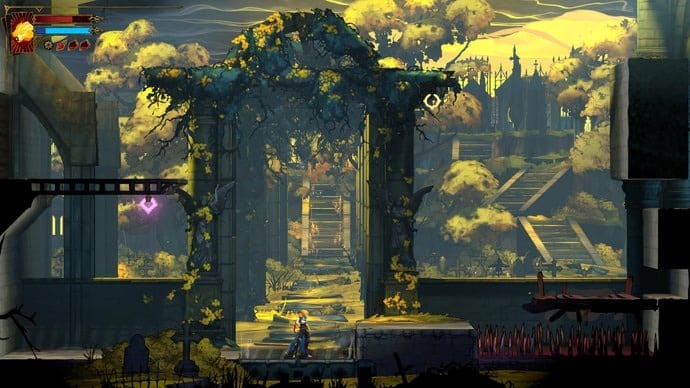
(Gothic horror and chic is something Symphony helped pioneer, and Belmont’s Curse carries that legacy forward.)
Not that the story of a Castlevania game is all that relevant—whip here, Dracula there, go!—but here’s a quick summary. We’re back in the original timeline; Lords of Shadow never happened, and Belmont’s Curse fits in between the third NES game and the first Game Boy title. In Paris in 1499, it’s Rose Belmont’s turn this time to give Dracula a taste of her whip—and let’s skip a few details: Not much else happens in *Belmont’s Curse* by the end of the night. As I said, classic *Castlevania*, just the way it should be.
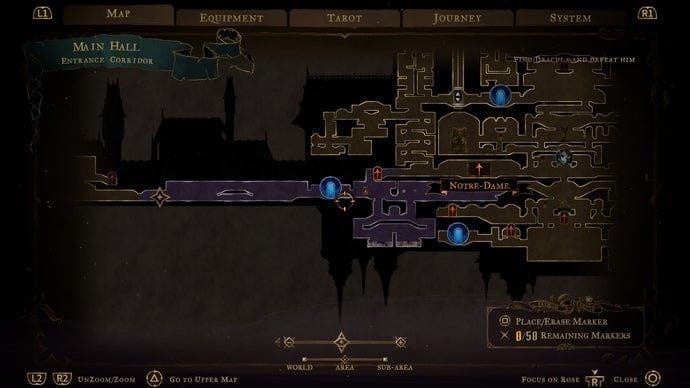
(Vast Playground: Castlevania: Belmont’s Curse offers six large areas, some with two levels.)
However, the world of Metroidvanias has come a long way since the good old PS1 days. The handheld Castlevania games have always been in a league of their own, but there are now some excellent major entries in the genre, such as the Ender and Hollow series, or the outstanding Prince of Persia: The Lost Crown. In fact, the genre is thriving, so a return of the original pioneer naturally raises expectations. And here, I’m afraid I have to say that while *Belmont’s Curse* doesn’t disappoint, it ultimately isn’t quite as spectacular as I’d hoped at times.
For the first few hours, you’ll explore Paris before heading to Dracula’s castle—of course. The whole thing is divided into six very large areas and one final tiny section, all connected by one or two paths. The path is linear at first, largely limited by what you’re capable of. As is typical for the genre, that isn’t much: a weak weapon, a jump, and not much else. The first boss soon grants you the ability to swing on anchors using a whip, which will remain by far the most important ability until the very end. Double jump, air boost, and downward smash all play their part in opening up new paths, but the whip swing remains the defining element throughout one of the most skill-oriented Castlevania games ever.
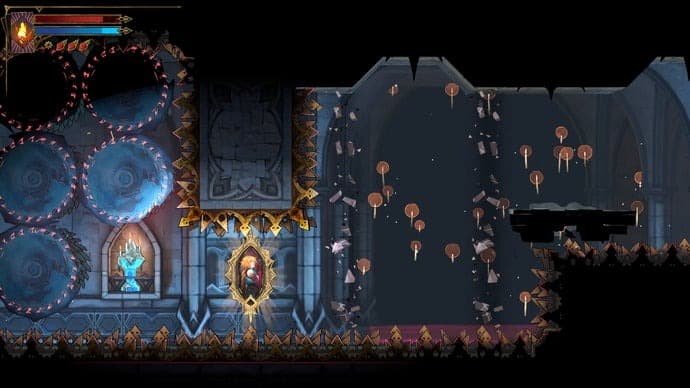
(This is what a good portion of the game world looks like: There’s hardly anything that isn’t out to get you.)
Many games in the series focus primarily on combat, and there’s no shortage of it in Belmont’s Curse either. But aside from the bosses, these fights aren’t particularly challenging or demanding. The whip is relevant here as well, since you can use it to quickly pull yourself toward an enemy—even in mid-air—but it isn’t the main weapon. You have a whole selection of weapons to choose from, ranging from a simple sword to a spear, a shield and sword combo, a two-handed sword, and, of course, a battle whip. They all work; in the end, it’s purely a matter of personal preference. For me, it came down to the whip, simply because its range was outstanding and the damage was high enough. Even if it makes sense to switch weapons for one boss or another—the combat gloves have an extremely high attack speed, and against a boss that always closes in for close combat, range matters—in the end, just use whatever you like.
The whip for swinging, on the other hand, is always available, no matter which weapon you’re equipped with, and this is where the traps in the catacombs and castle halls come into play. I’d say at least half of all rooms have nothing better to do than impale you, shred you, crush you, or reset Rose to the start of the room in other ways. In some cases, you’ll have to make 15 or more swings, jumps, or boosts through completely deadly environments to safely reach the other side. Once there, you can usually unlock a shortcut so you don’t have to go through that every time, but the first time is a real challenge.
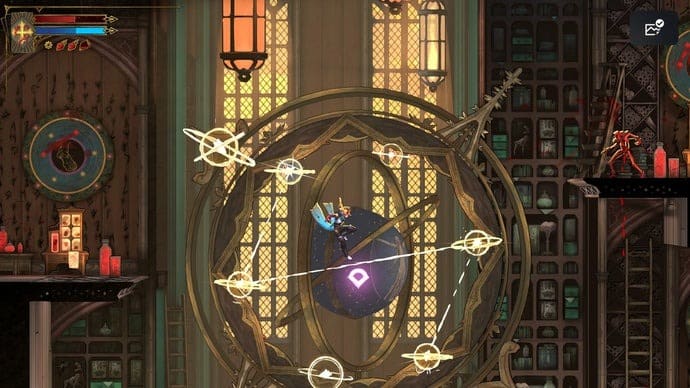
(But there’s also plenty of variety in Belmont’s Curse—not just in the fights, but also in some really nice puzzles.)
So it’s a good thing the controls are up to the task. Evil Empire has come a long way since The Rogue Prince of Persia, and Rose navigates even the trickiest spots with confidence and precision. Most of the time, though—the jump timing is a bit delayed here and there, but nothing you wouldn’t get used to very quickly. She also moves significantly slower and with more gravity than the extremely fast hero from Dead Cells, which makes Belmont’s Curse feel much more like a Castlevania game. There were countless rooms I entered where I briefly despaired, thinking, “How am I supposed to do this?” only to make it through after a few tries. Simply because Rose is so precise to control. It also helps that, even on the regular difficulty level, you don’t take that much damage from traps when you’re reset. That keeps frustration to a minimum and encourages you to keep trying. Which I was always happy to do, because as frustrating as it might be at times, it was always a lot of fun in the end. So it’s the right kind of challenging.
Overall, the difficulty level is set very sensibly. You have the regular—or should I say unmodified—level. Enemies are a bit tougher, some bosses are really hard, and the traps aren’t too bad. Instead of fixed difficulty levels, you can fine-tune everything separately. Enemy damage can be increased or decreased in 10-percent increments, all the way down to practically no damage. Traps can be adjusted separately, as can the damage you deal. If you want more XP per kill, just set it that way; and if you’re annoyed that you have to walk back to the boss from the last save point, you can change that too and start right back at the boss. You can even adjust the number of healing potions—all without any penalties. True to the motto that it’s your game and you should play it however you want. Awesome, fantastic—I love it; I wish every game were like this.
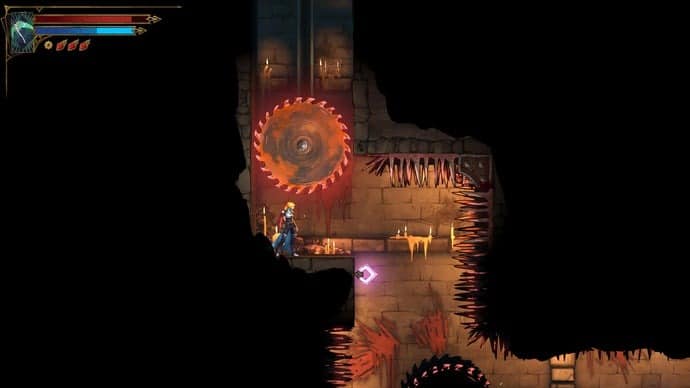
(Roses’ well-designed controls guide you safely through areas like these in *Castlevania: Belmont’s Curse*.)
The game’s very consistent approach of not holding your hand too much also has its charm. Once you’ve defeated a few bosses and gained more skills, you can explore a lot but still find yourself stuck because you overlooked some corner. There’s nothing more satisfying than stumbling upon a new path somewhere, only to discover an entirely new area and truly feel like an explorer. Sometimes there’s also nothing more frustrating than running in circles and getting stuck, but that’s a price I’m happy to pay in a game like this. Add to that a few very solid puzzles, which can be found in almost every area, and you’ve got a truly well-rounded, expansive, and highly playable Metroidvania.
But also one that, in the end, plays it a little too safe for my taste. For a long time, I thought there must be a lot more to come, since I was still missing nearly half the bosses, but once you reach the point where you can fight Dracula, there isn’t much more in the way of optional content or excitement. Symphony is still legendary today for turning its world upside down, but there’s no 178 percent here. If there really are some weird secrets, I’m looking forward to discovering them, but after reaching the 100 percent I have now, I’m not expecting any miracles. In the end, it wasn’t a deeper dive into the world, but just a bit of the usual run-through of the rooms that were still marked gray instead of gold on the map. Nice, but nothing special.
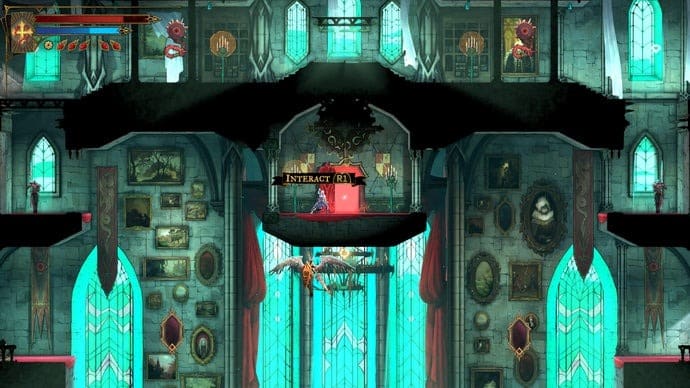
(Alucard is mentioned more than just a few times. Is someone warming up for Symphony 2?)
The enemies aren’t exactly mind-blowing either. Sure, all the usual elements of a Castlevania game are handled with flawless precision. Magnificent castle rooms, clock towers gone haywire, skull-strewn catacombs—the classic set pieces are played out exactly as expected. Add to that a dozen or so familiar monsters, and of course, Death is a must among the bosses. But none of the new bosses are likely to be remembered as iconic ten years from now; Dracula only has two rather lackluster phases. It’s all fine, but from a franchise with such legendary monsters and encounters, you just expect a little bit more.
Technically, it’s solid, but unspectacular. There are plenty of captivating moments—like the castle rising from burning Paris and some absolutely gorgeous individual rooms—but there’s also a lot of run-of-the-mill content in between. Sure, no Metroidvania shines on every single screen, but the design here stays too safe. Calling it “run-of-the-mill goth horror” might be a bit too harsh, but it’s certainly heading in that direction. Musically, it shines whenever familiar themes from the series are remixed and rearranged. Which is practically always the case, so no complaints there.

Castlevania is back with *Belmont’s Curse*—that’s the good news. It’s made its comeback after nearly a decade and a half, perhaps a bit too conservatively, but very competently, and that alone makes me happy. Up until the middle of the game, I even thought it might set new standards for the genre, but then it played it too safe by sticking to what it had established up to that point and expertly carried the game through to the end—which took about 20 hours, so it was very solid. I have a wish list for a sequel, but fortunately, it’s just a list of things I’d like to see added to *Belmont’s Curse*. Maybe a few new enemies, a bit more daring when it comes to the oddities, and little tweaks here and there. The core framework, however, is flawless, and Evil Empire built upon it to create a game that fits wonderfully into the series. I really had a lot of fun finally getting to polish Dracula’s fangs with my whip again, and after this successful outing, I sincerely hope I won’t have to wait another dozen years for the next chance to do so.


