





Remedy has tester Natalie completely wrapped around its finger after just a few moments. It turns out that Finnish magic works in Manhattan, too.
“Oh, what’s this? Oh, and what’s that? Can I go in here? Haha, that’s so cool! And what’s that?” Control Resonant is a massive adventure playground where I discover a secret in every nook and cranny, no matter how small. I really didn’t want to put the controller down and wanted to turn every street sign in Manhattan upside down.
But it wasn’t my mom—Federiiiico, lalalalalala—who dragged me off the streets of Manhattan; it was my stupid 38.5-degree fever. After about 18 hours, I had to temporarily put my playthrough on hold due to illness. So you won’t be getting a final review just yet, but rather a first impression of what Remedy has in store for us. And even the first few hours are packed with action!
Table of Contents
Manahattan at a 90-degree angle
Remedy’s games take place in the year they are released. So seven years have passed since Part 1—and Dylan finally awakens from his long coma. It doesn’t take long for him to realize that quite a few things have gone off the rails in the meantime. A loud alarm siren serves as a not-so-subtle hint.
First major problem: His sister Jesse has disappeared. In the first Control, she wasn’t just the game’s heroine, but also the newly appointed director of the FBC, a secret organization dedicated to investigating and capturing paranormal objects and events.
Second major problem: The lockdown of the FBC headquarters—the so-called House of Elders—has been lifted. It had been declared in the first Control because a phenomenon called “Zischen” had wiped out a large portion of the staff or turned them into quasi-paranormal zombies.
Unfortunately, the lockdown wasn’t lifted because the danger has finally been averted. On the contrary: The Hiss somehow managed to escape from the House of Elders and is now casually hanging out on the streets of Manhattan.
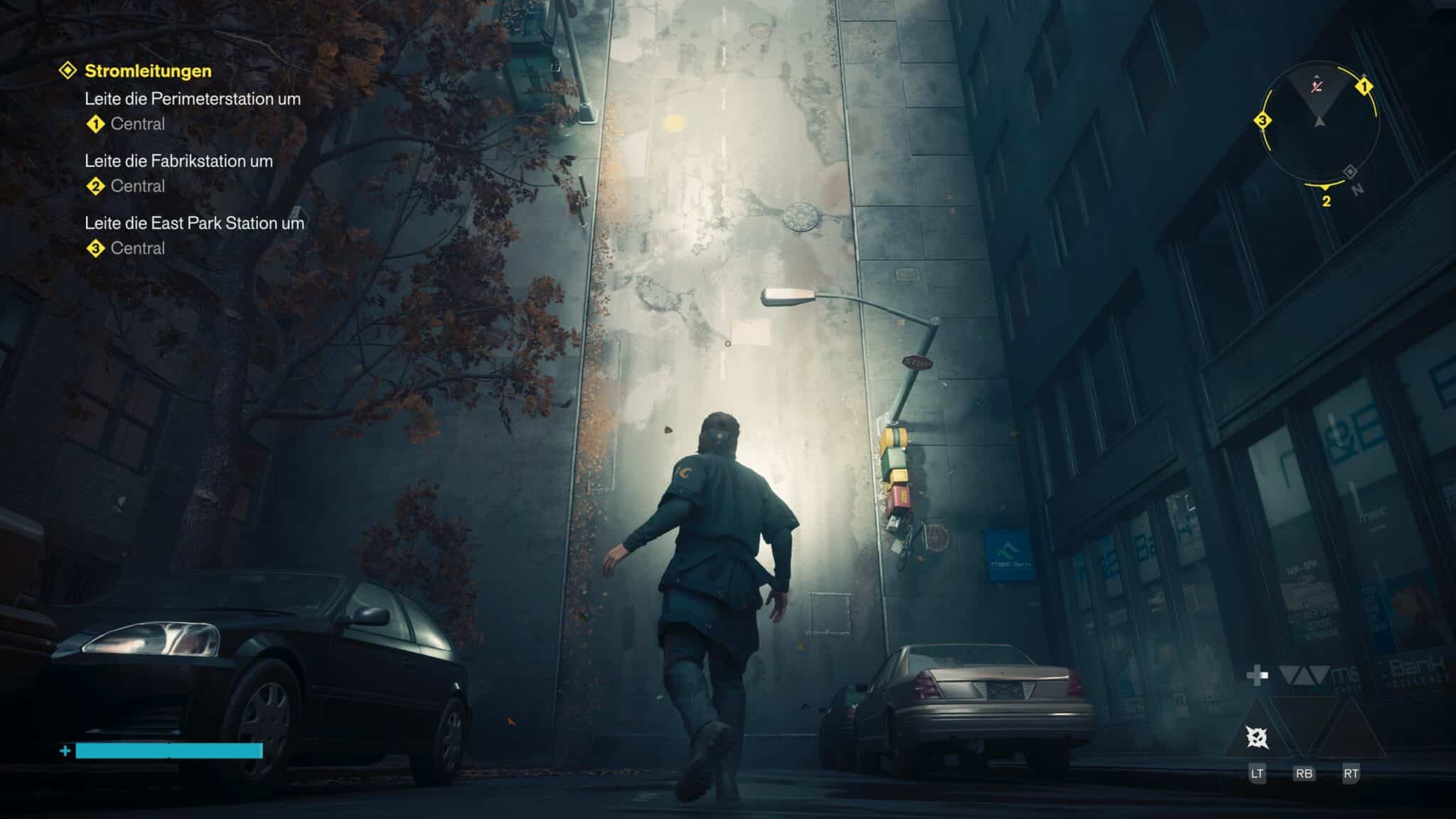
(In *Control Resonant*, the city folds up like a magical origami.)
But the Hiss isn’t Dylan’s only problem. A new anomaly called “Pattern” is wreaking havoc in New York, literally folding the metropolis in on itself. Streets suddenly bend upward at unbelievable 90-degree angles, pigeons freeze mid-flight, and the entire city gradually transforms into an absurd maze— Inception, take note.
Along the way, I run into old acquaintances like Emily Pope, but also meet some fantastic new characters. I took Zoe in particular to my heart right away. The FBC agent not only explains this completely crazy “new” world to Dylan, but also has to step in for him time and again—because by no means has everyone at the FBC forgiven him for his dark past.
If you’re now left with question marks floating above your head, you really should play the first Control before venturing into Resonant. Although a video provides a summary of the first game in the series, the mere five minutes aren’t nearly enough to convey its equally convoluted and complex story to those unfamiliar with the previous installment. Feel free to test it out for yourself:
At first, I was incredibly skeptical about whether it was a good idea to abandon the Oldest House as the setting. After all, for me, the office building was never just a backdrop—it was a character in its own right. A living organism with an eerie personality. But Remedy handles this shift to the streets fantastically.
Fortunately, the developers resist the urge to create a generic open world and instead opt for open areas with linear pathfinding and classic Metroidvania elements, just like we saw in the first game. This means I often see places I can’t reach until later, once I’ve learned the appropriate ability.
Despite this linearity, Control Resonant creates the perfect illusion of a vast, overwhelming city. After all, when I’m not yet allowed to enter an area, I don’t just run into an invisible video game wall. Instead, perfectly logical barriers block my path—whether it’s a cordoned-off area set up by an FBC field team or simply the fact that half a block in Manhattan has been completely demolished.

(As a parautilitarian, Dylan has mastered unusual abilities—such as gliding.)
From honking taxis to potted plants in distress
For me, the biggest highlight in Control Resonant so far has clearly been the various quests and absurd encounters that Remedy has once again come up with. Away from the main story, I literally stumble upon new, exciting tasks at every turn, discover secret hideouts, and lose myself in stacks of documents that reveal more about the lore.
Control Resonant offers a handful of different quest types. There are small, self-contained side quests with exciting or funny stories—like when I have to save some guy’s beloved houseplant, completely without irony. Once again, Remedy manages to have me sitting in front of the screen in tears one moment and having my herbal tea run out of my nose the next because I was laughing so hard at something.

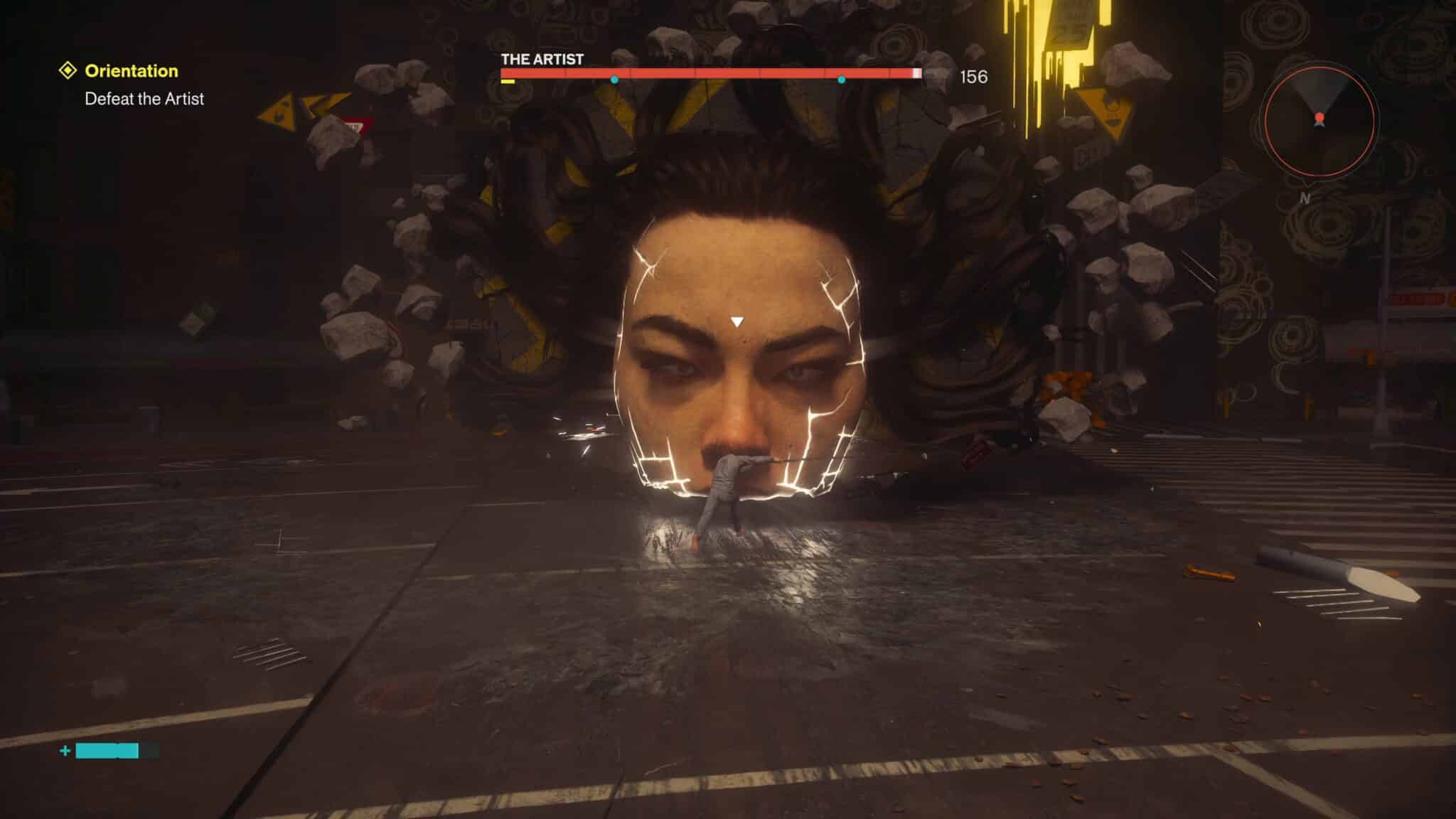
(This boss used to be an artist who was mutated by the Pattern. The fight against her is quite a challenge.)
Things get really uncomfortable—but also outrageously spectacular—when we encounter the eponymous Resonants. The anomaly transforms humans into giant monsters. And they’re quite a challenge.
Even the very first battle against a mutated artist turns out to be a brutal bottleneck—one that took me, even as a Soulslike fan, a good ten tries to beat. You’ll only make progress here if you master Control Resonant’s comprehensive and thoroughly complex melee combat system.
The biggest unique feature: There are neither parries nor counters, which definitely requires some adjustment. In Control Resonant, you only stand a chance if you take an aggressive approach, figure out your enemies’ attack patterns, and—most importantly—use the full moveset to close the distance. After all, Dylan can’t shoot, but your enemies certainly can.
As in the previous game, however, you can activate aids for the single difficulty level at any time—such as invincibility or reduced enemy aggression—if you want some help.
While the first Control still felt like a third-person shooter with wacky special abilities, Resonant is more reminiscent of a God of War on speed… with wacky special abilities.
The Swiss Army Aberrant
Just like in the previous game, there’s a lot of combat in Control Resonant. The action combat system doesn’t reinvent the wheel by any means, but to me it feels much more polished and fun than in the previous game.
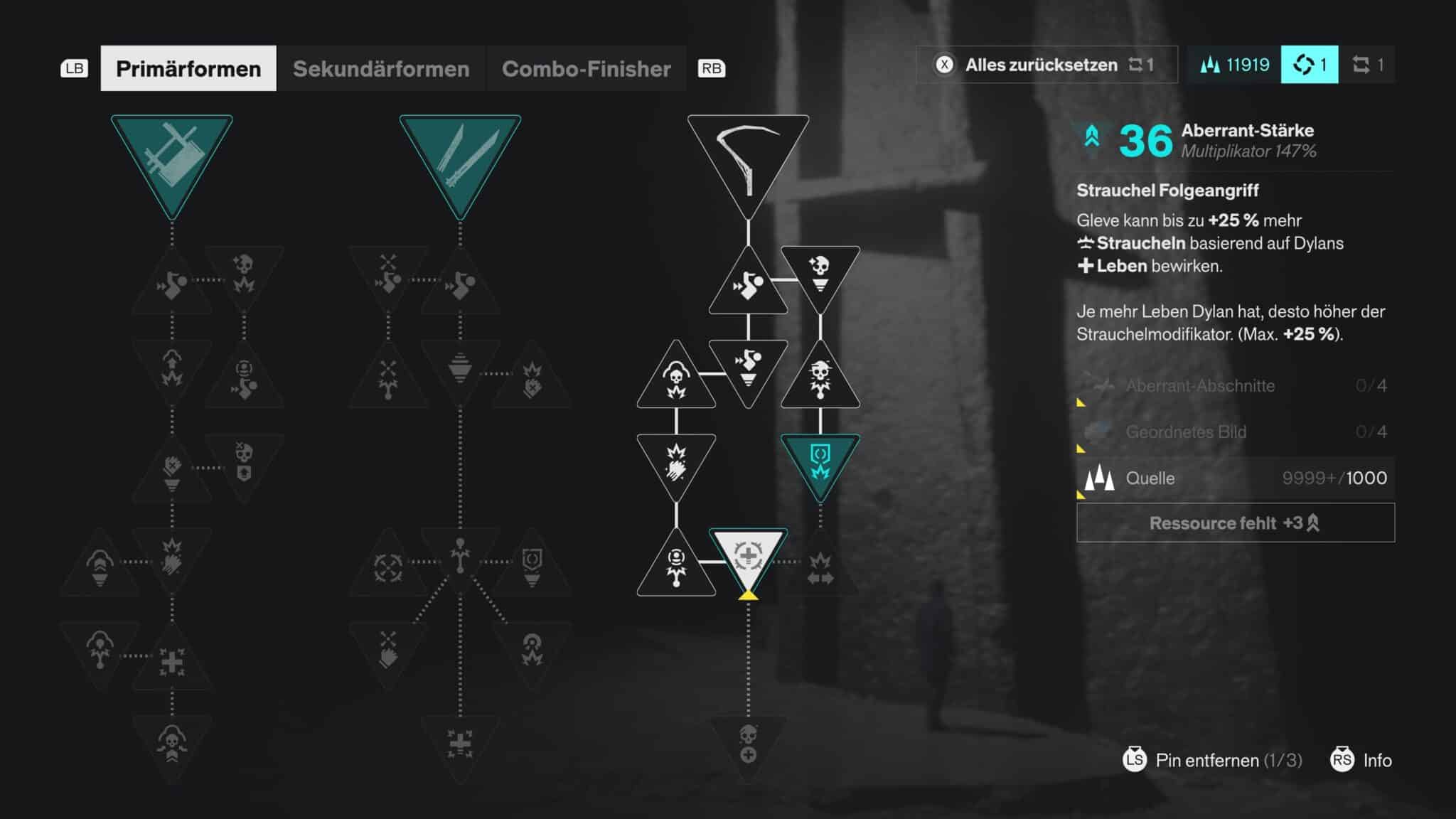
That’s mainly because I get to decide for myself how my build is put together. The linchpin is Dylan’s weapon, the so-called Aberrant, which can transform into three forms. So I choose between a hammer, a double-blade, and a sickle. With these, I perform light attacks and heavy special attacks typical of the genre, and top it all off with cool finishers.
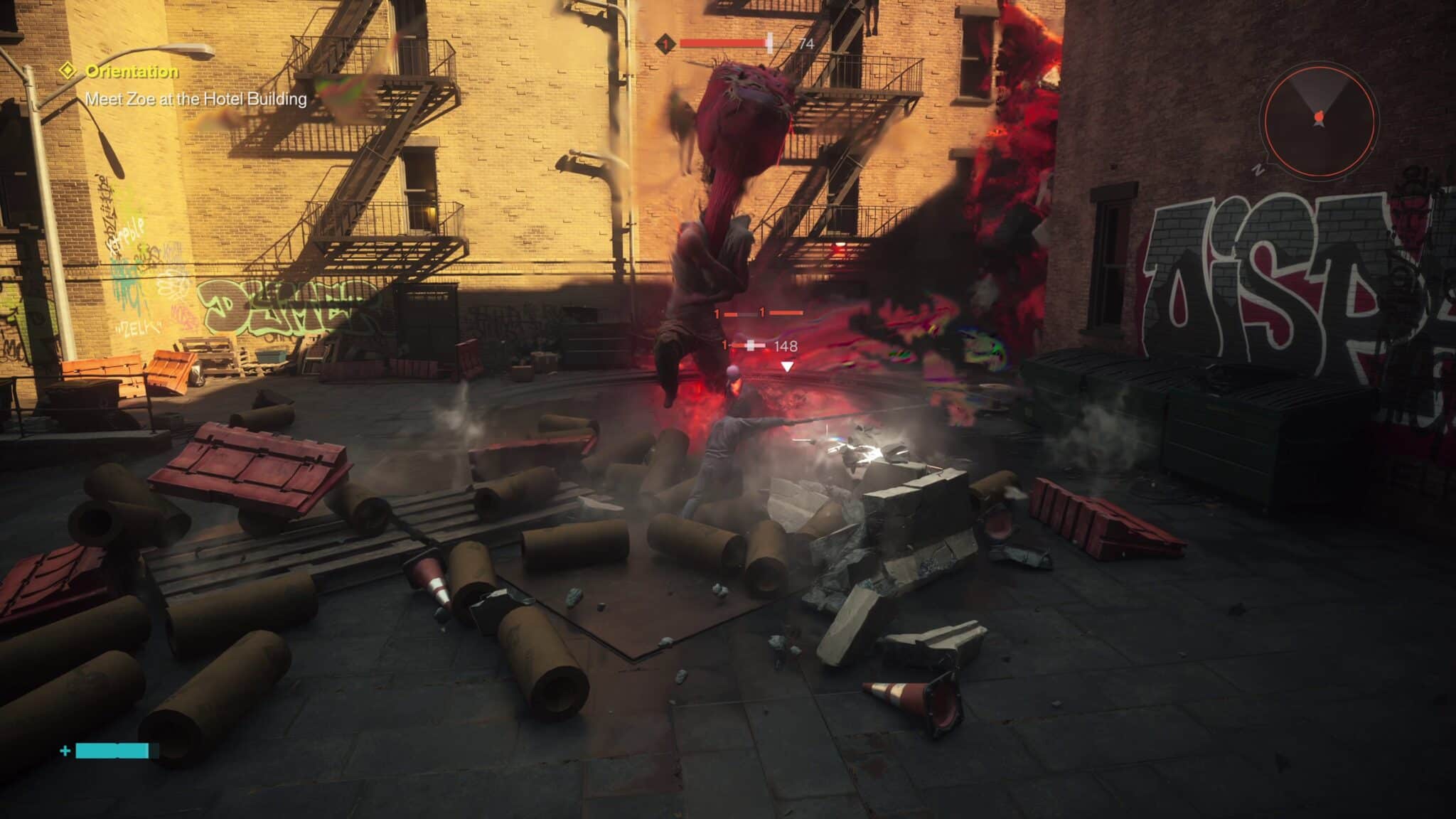
(With the sickle, Dylan has a relatively long range and can hit multiple enemies at once.)
If I defeat one of the big Resonant bosses, I get to choose a new special ability on top of that. The artist gives me a choice between telekinesis or a stone shield—which I already used in the first game—or a small stone companion that fires on its own and that I can make explode in the faces of my enemies at the push of a button.
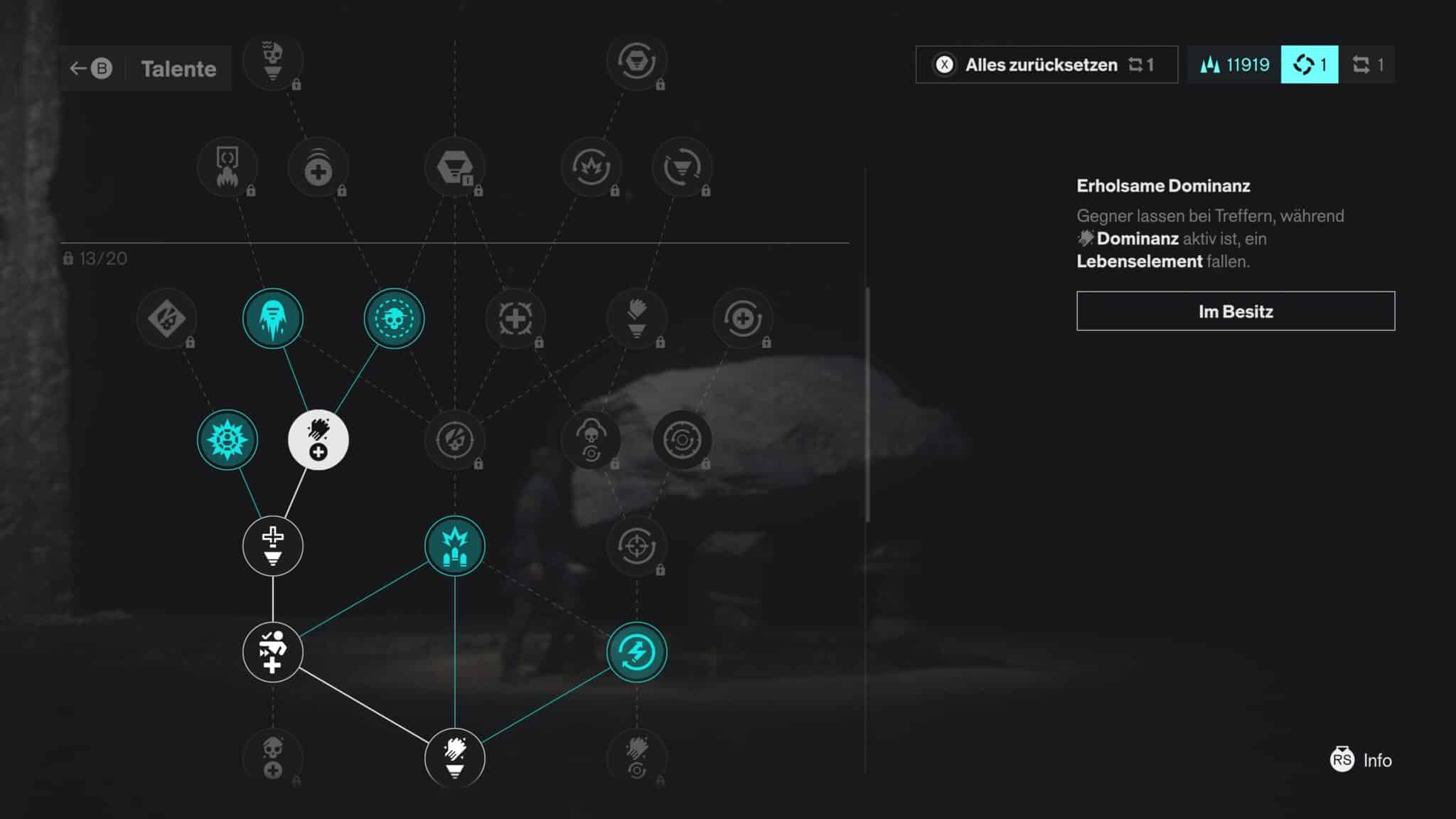
To stand a chance against the enemies in later zones, Dylan has to level up. This doesn’t just happen in the menu at a save point, but in the so-called “Gap,” a surreal world inside his head. Here, I visit different stations to, for example, craft amulets that grant me buffs; to choose my special ability; or to unlock my passive skills.
For my taste, this skill tree devolves too much into mere numerical window dressing. Whether I deal ten percent more stagger damage or not rarely feels impactful or noticeable to me in combat.

(If I defeat a Resonant, I gain a special ability. Here, Dylan summons a little helper.)
With the separate weapon skill tree, I notice the changes much more clearly. Here, for example, I unlock powerful finishers and increase my weapon’s overall level. If a mob at the intersection in the neighboring block was previously too high-level, I should be able to take them on without any trouble after just a few upgrades.
As mentioned earlier, the fights in Control against Resonants are definitely fun—but, as is typical for Remedy, they suffer from a few teething problems. Compared to other beat ’em ups like the aforementioned *God of War*, movement and maneuvering lack precision. The targeting system tends to act up, the camera sometimes chooses interesting but gameplay-unfriendly angles, and the on-screen displays can feel cluttered and hard to read at times. This can be annoying at times, but it never completely ruins the fun—especially since Control Resonant generally places checkpoints fairly.
A notable exception is the spectacular—but also very challenging—boss battles, which often last for minutes and span multiple phases, yet must be defeated in a single go.
What Remains Unclear After 18 Hours
Control Resonant immediately pulls you in like nothing else. After my 18 hours, I’ve barely scratched the surface of what Remedy has cooked up here in Manhattan.
Before I can give a final rating, I’d like to address a few lingering questions:
- Where is the story headed? Will Remedy deliver a satisfying conclusion to this wild ride that fits nicely into the existing lore?
- How big is the world? How many zones are there, and how different do they feel?
- How high is the grind factor? Some main quests require me to complete other tasks first, such as the Resonant battles. But since these bosses are pretty powerful, that could lead to annoying grinds just to level up Dylan’s weapon.
- How does the balance evolve? Does Dylan ever feel overpowered? Does the skill tree eventually have a greater impact on my gameplay experience? How different do the builds actually play?

(To put it simply: Control Resonant is just plain fun.)
As soon as my thermometer reads normal again and I’m no longer coughing at 5,000 km/h, I’ll dive right back into the surreal New York playground.
But I can already say this: If you’re a fan of Remedy games, you’ll love the little stories and cinematic moments. You just have to decide whether the combat system is for you or not.For my part, I’m once again absolutely thrilled that there are still studios like Remedy that show me why I actually love video games so much!
Provisional Standings Box
| Category | Pros and Cons | Rating |
|---|---|---|
| Presentation | + Spectacular Inception-style level design + Great lighting, especially with ray tracing + Good voice actors – Stiff facial expressions and gestures ? Does Manhattan become too monotonous over time? | 3-4/5 |
| Game Design | + Manhattan as a fantastic Metroidvania labyrinth + magnificent quests with unique ideas + diverse weapon types and abilities ? Do the skills in the skill trees get even more exciting? ? Does the mix of exploration and combat keep you engaged until the end? | 3-5/5 |
| Balance | + Many optional settings for difficulty and accessibility – Imprecise targeting and a cluttered UI during combat – Significant fluctuations in enemy difficulty early on ? Do skill trees eventually have a noticeable impact on your build? ? Where does the difficulty level out in the long run? | 1-3/5 |
| Story/Atmosphere | + Typical Remedy flair at every turn + Absurd and captivating side quests + Grandiose staging of bosses and quests + A bottomless well of lore ? How does the main story unfold? | 4-5/5 |
| Scope | + 50+ hours of gameplay + Various build options available + Many optional tasks and collectibles ? Does the playtime feel stretched out by grinding? ? How large and diverse is the world, really? | 3-5/5 |
| Rating Forecast | “A surreal and beautiful adventure playground: The signature Remedy magic makes you overlook minor flaws.” | 82-86 |
Editor’s Verdict
“I love Remedy!” That thought kept popping into my head over and over again during my 18 hours with Control Resonant. That’s because the Finnish studio isn’t afraid to try new things, to be silly—and, as in this case, to reach for the stars. Control Resonant is the studio’s biggest game yet, and I can really feel it. I’d only just scratched the surface, had only just found my way around the first few areas—and then the timer beeped. You can’t even imagine how frustrated I was that I had to stop this playthrough!
Control Resonant had me hooked right away, presenting me with stories I can’t experience like this in any other game and making me curious about everything that lies ahead. I’m going to go back to sipping herbal tea and inhaling deeply now, because I want to let Control blow my mind again as soon as possible!


