





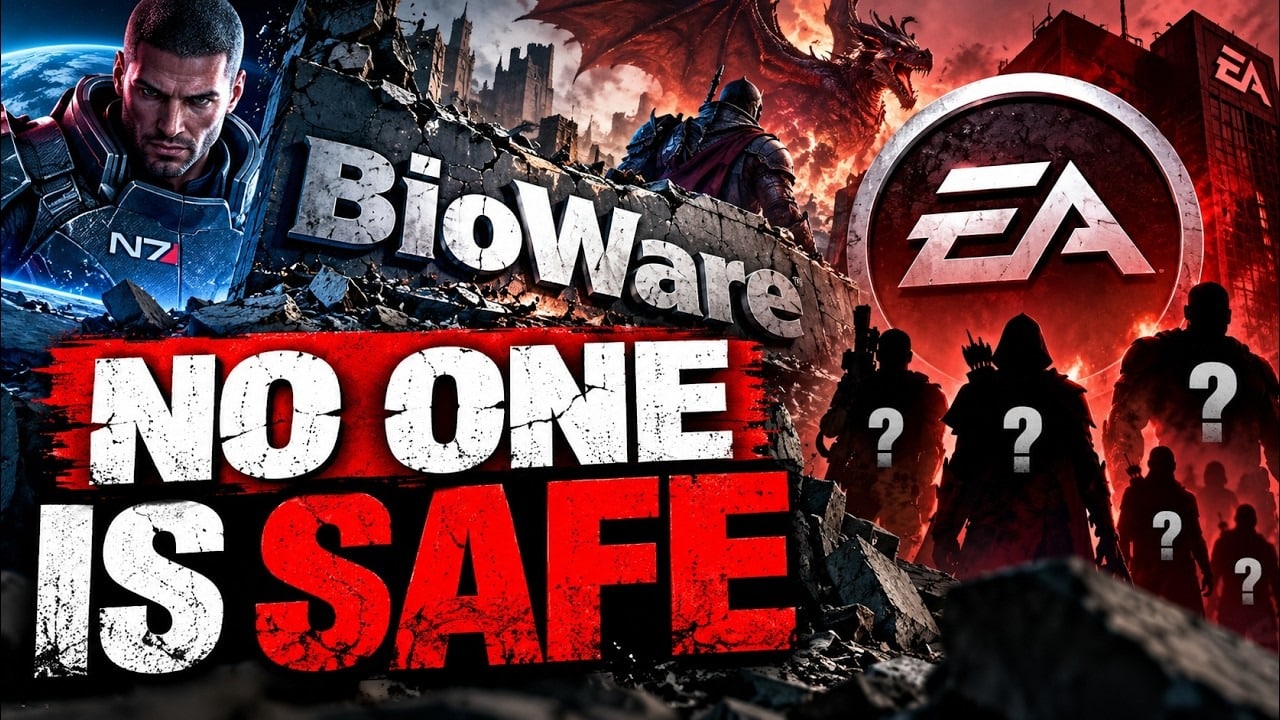
Consumers and employees are learning the hard way: Companies—especially publicly traded ones—aren’t your friends. They never were. They never will be. The latest example: Bioware.
Dear readers,
No matter how hard you try not to look surprised—you still end up a little taken aback when it actually happens.
That’s how it was with the now fourth (!) Karstadt-Kaufhof-Galeria bankruptcy in six years, with “Wetten dass …?”, with Brexit, with the bursting of the dot-com bubble, with “Unter Uns,” with “Emma”—and that’s how it is now with the demise of the Bioware brand.
Founded in the same year I signed my first employment contract as a young editor (namely 1995)—and owned since 2008 by the U.S. publisher Electronic Arts, which is now owned by the Kingdom of Saudi Arabia.
What Bioware built in its first two decades belongs on the top shelf. The games had a formative influence on much of what came after—on careers, on companies, on the industry. CD Projekt Red CEO Michal Nowakowski describes on X how he once translated and distributed BioWare games in Poland, the Czech Republic, and Slovakia. They visited each other—and held each other in high regard.
“Not a great day in the games industry.”
But the chronology of events left no room for any other punchline.
Because Bioware’s shine has been tarnished: Since the Game of the Year, Dragon Age: Inquisition (2014), nothing substantial has been achieved. Decent sales figures and reviews, as in the case of Dragon Age: The Veilguard (2024), simply don’t cut it in this market environment—especially not for the decision-makers who give the green light to follow-up projects or—as in the case of Mass Effect 5—reject them.
As a result, the studio has been steadily stripped down—both in terms of content and staff. From 200 (2023) to 100 (2025) and now just under 50, who are losing their jobs, just like hundreds of others. Eventually, all that’s left is an empty shell capable of producing nothing more than remakes and remasters—at which point it doesn’t even matter whether Gothic is developed in the Ruhr region or in Catalonia.
These are the well-established mechanisms of an industry that traditionally shows little mercy toward struggling brands and production facilities. It’s incredibly difficult to constantly reinvent yourself in order to avoid alienating existing customers while simultaneously reaching new ones. Just ask Activision Blizzard. Or Ubisoft. Japanese game developers often manage this brand and customer care quite well—Resident Evil, Final Fantasy, and Nintendo, of course.
It was foreseeable that a studio like BioWare might no longer play a role in Electronic Arts’ future structure, at the very latest following the Saudi offensive. Why? Electronic Arts is sitting on a $20 billion mountain of debt and needs to pay it off. Analysts have crunched the numbers and concluded that the gaming conglomerate has no choice but to maximize revenue while simultaneously slashing operating costs (i.e., personnel)—and with the lawnmower set to the lowest setting, as I wrote in a column back in July.
It should come as no surprise to anyone that the first effects are now becoming apparent. More will follow.
And where is this growth supposed to come from? EA is relying more than ever on sports and action games, preferably based on licenses: soccer, Formula 1, the NFL. For the recently extended seven-year deal with the Bundesliga alone, EA is reportedly set to put a quarter of a billion euros on the table.
In areas where competition is far fiercer—such as role-playing games or racing games—they’re leaving the market to others. To put it positively: focus, focus, focus. Take E Need for SpeedE and E BurnoutE , for example: caught between E Forza HorizonE and E GTA 6E , there’s no room for overtaking maneuvers. In any case: not enough.
The model resembles that of Take-Two, where, alongside Rockstar’s perennial hits, it’s sports titles like NBA 2K or WWE 2K that consistently deliver strong commercial results. In the console market—which, due to astronomical chip prices, is barely growing and is essentially just maintaining its existing customer base—this is worth its weight in gold. On the list of best-selling PS5 games in 2025, EA took three of the top five spots.
It’s usually the indie and AA productions—with a wide range of budgets—that break through this phalanx—and which then very reliably sweep up the Game of the Year trophies. A *Clair Obscur*, an *It Takes Two*, a *Baldur’s Gate 3*.
Given the current state of affairs, it’s unlikely that the gaming industry will learn any lessons from the Bioware affair. Iconic studios and even more iconic franchises will continue to be acquired, always with the clear promise that value will be created for employees and customers. The opposite is almost always true—perhaps not immediately, but certainly in the medium term, with a few notable exceptions like Mojang and Minecraft.
The acquisition sprees by Sony PlayStation, Embracer, and Microsoft alone have left trails of devastation in their wake; the ripple effects of cost-cutting measures reliably reach even the farthest corners of these corporations. The more heartfelt the internal and external “We Are Family” messaging, the louder the alarm bells should ring.
After Bioware is before Bioware. What remains is the resolution to appear just a tiny bit less surprised next time.
Wishing you a wonderful weekend
Petra Fröhlich
Editor-in-Chief, GamesWirtschaft


