






At Nvidia, Multi-Frame Generation has long been a standard feature of DLSS, while AMD is still lagging behind with FSR. But that could change soon.
It’s no longer a secret that AMD is working on its own multi-frame generation for FSR—there were already hints of this back in April in the ADLX-FidelityFX SDK.
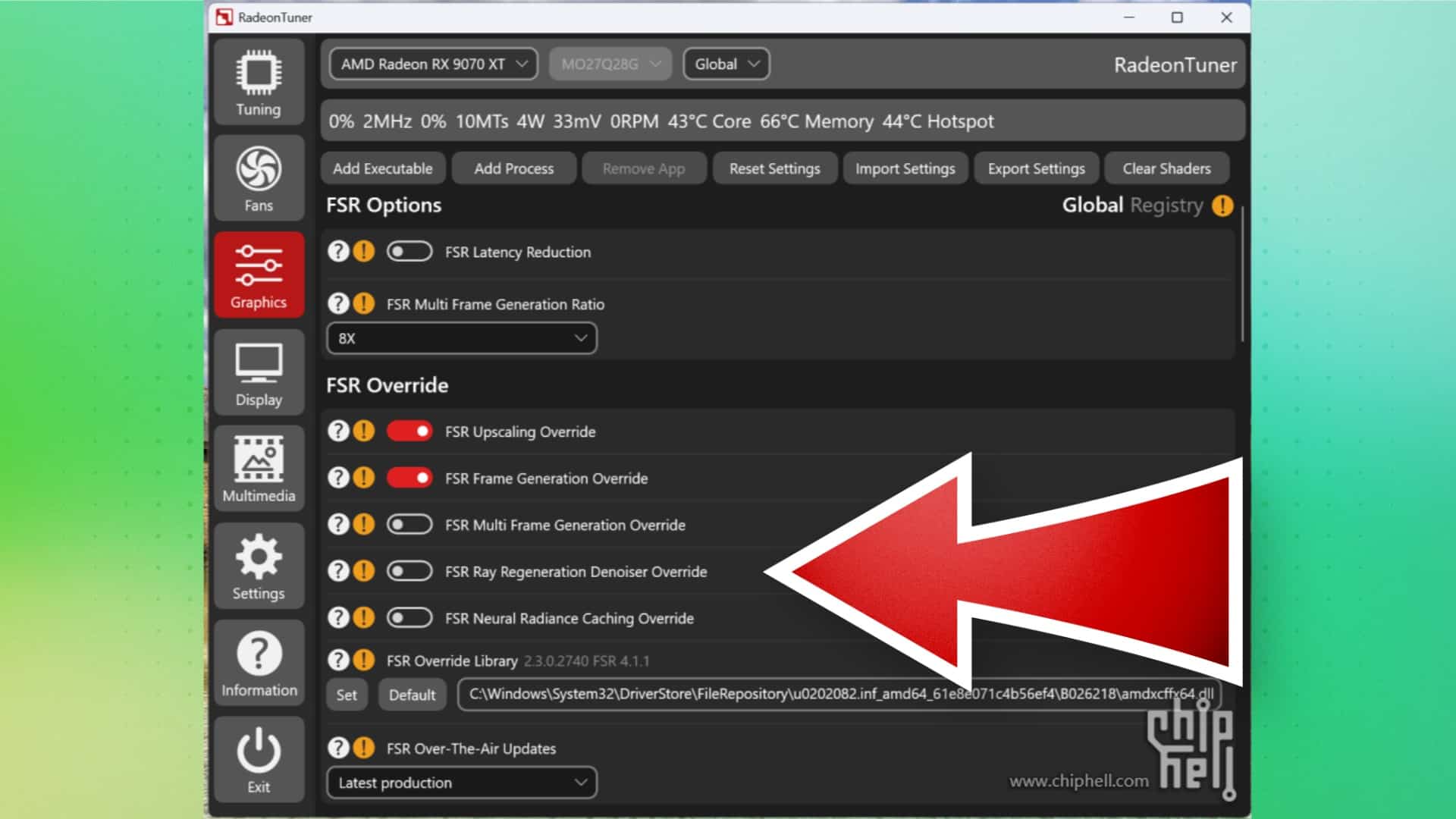
Just how far along the technology is now is revealed by a discovery from theChiphell forum: Using the community tool RadeonTuner—a leaner alternative to the official Adrenalin software—a user has uncovered hidden options in the current Adrenalin 26.6.2 WHQL driver.
RadeonTuner can reveal features that are already built into the driver but do not yet appear in the standard software.
On a Radeon RX 9070 XT, four new, previously hidden entries were found in the Graphics tab under FSR
four new, previously hidden entries: an option for the Multi Frame Generation ratio with values up to 8x, a general override switch for it, as well as overrides for FSR Ray Regeneration and FSR Neural Radiance Caching.
Up to 8x: More generated images than with Nvidia
The multi-frame generation (MFG) value of up to 8x is likely to be of particular interest.Nvidia’s current DLSS 4.5 maximum is MFG 6x, which means five additional generated images per natively rendered frame and is currently exclusive to the Blackwell-generation RTX 50 graphics cards.
If AMD were to actually implement an 8x mode, there would be seven generated frames for every real frame—two more than NVIDIA’s best. Currently, AMD only offers simple frame generation with one additional frame per real frame; a jump straight to 8x would be technically ambitious.
- However, more generated frames also mean more challenges in terms of frame output timing and input lag. AMD’s anti-lag technologies would therefore likely need an update as well if the 8x mode were to actually be introduced.
- Nvidia itself had already hinted at a possible 16x mode during the Blackwell unveiling (viawccftech); Intel currently offers “only” 4x.
Intel Catches Up to Nvidia and AMD: First Arc GPUs Get Modern AI Feature for Significantly More FPS
Ray Regeneration and Neural Radiance via Override?
Just as interesting as the frame generation news are the two other discovered overrides: FSR Ray Regeneration (noise reduction for ray-tracing effects) and FSR Neural Radiance Caching are currently available in only a limited number of titles, including Call of Duty: Black Ops 7 and Crimson Desert.
Both features were introduced as part of the “Redstone” announcement, which is intended to take current upscaling to a new level.
AMD has not yet officially confirmed any of this. While the features are presumably included in the driver, they are neither visible in the regular Adrenalin interface nor accompanied by an announcement date. Whether and when AMD will actually enable 8x multi-frame generation for gamers therefore remains to be seen for now.


