






In preparation for “Songs of the Past,” the hit role-playing game is getting a comprehensive technical update. The review shows: The Witcher 3 is still outstanding, but even the remaster can’t eliminate all its weaknesses.
The king of the role-playing genre is back! Upon its release in 2015, The Witcher 3: Wild Hunt raked in record-breaking scores from the international press. Thanks to the 2022 next-gen update, Geralt the Witcher’s latest adventure to date holds one of the highest scores in GameStar history with a 94. In the eyes of many fans—and our author Jesko as well—The Witcher 3 is one of the best video games of all time.
Now, 11 years later, developer CD Projekt wants to revamp the game for another DLC and is treating the third installment in the series to a major remaster. The Hungarian team at Yigsoft, consisting of many former Witcher modders, is responsible for this project. But how exactly do you make one of the best role-playing games in the world even better?
Among other things, the remaster tweaks the graphics, combat, and skill systems of The Witcher 3 and refines many small details. But the best part is: You won’t have to pay a single Novigrad crown for it—the update to the remastered version is completely free for all owners of The Witcher 3. The two previous expansions, Hearts of Stone and Blood and Wine, are included for free as well.
You should already find the new Complete Edition in your Steam and GOG libraries; on September 29, it will automatically be replaced with the remaster.
Table of Contents
Geralt, Ciri, and Co.
The latest Witcher remaster is primarily intended as a visual enhancement of the base game, with a few subtle gameplay adjustments to combat, the skill system, and the controls. However, it doesn’t change a thing about the already outstanding story of The Witcher 3. You’re still playing as monster hunter Geralt, searching for your adopted daughter Ciri, making difficult moral decisions, and crossing swords with the riders of the Wild Hunt.
For a completely new story, you’ll have to wait until 2027; that’s when Songs of the Past will be released, marking the final conclusion to Geralt’s adventures. Really handy: If you still have old save files, you can easily carry them over to the remaster—even very old saves from 2015 still work. You don’t necessarily have to start from the beginning in the remaster. But we’ll get to why that might still make sense in a moment.
In the game world, too, everything remains the same: Each area retains exactly the same charm as in the original main game: Velen is gloomy and desolate, Skellige is rugged and beautiful, and Toussaint is warm and invitingly Mediterranean.
The Witcher in its most beautiful form yet
And that brings us right to the new features. Even at first glance, it’s striking just how beautiful The Witcher 3 still is, even after 11 years. The game was a visual stunner right from its release—and it remains so with this remaster. Higher-resolution textures, denser vegetation, and an overall sharper—albeit slightly desaturated—image: A lot of work has gone into tweaking the graphics to bring the game up to modern technical standards.
You really notice that there’s another significant visual leap between the remaster and the 2022 next-gen update when you compare the two versions side by side. I couldn’t have said that just from memory—in my mind, The Witcher 3 has always looked fantastic.
What really stands out about the remaster, however, is its support for advanced ray tracing and path tracing, which allow for more accurate calculations of light reflections and mirror effects. But this comes at a high performance cost. With path tracing enabled, the frame rate can drop by as much as 60 percent in some cases.
Without frame generation to compensate, the frame rate on an RTX 4070 Ti with 32 GB of RAM hovers around 45 FPS with occasional stuttering. For anyone who wants to use path tracing, an extremely powerful graphics card and frame generation are practically a must.
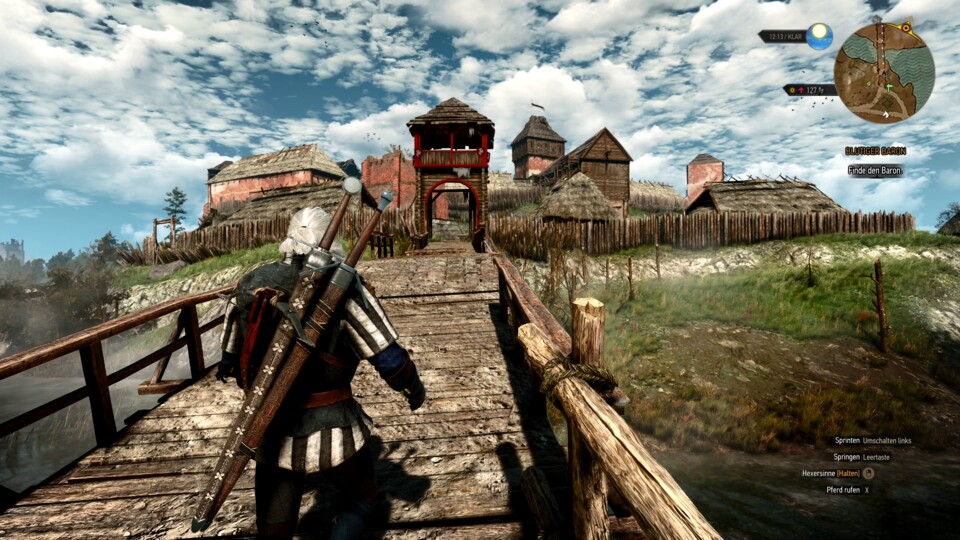
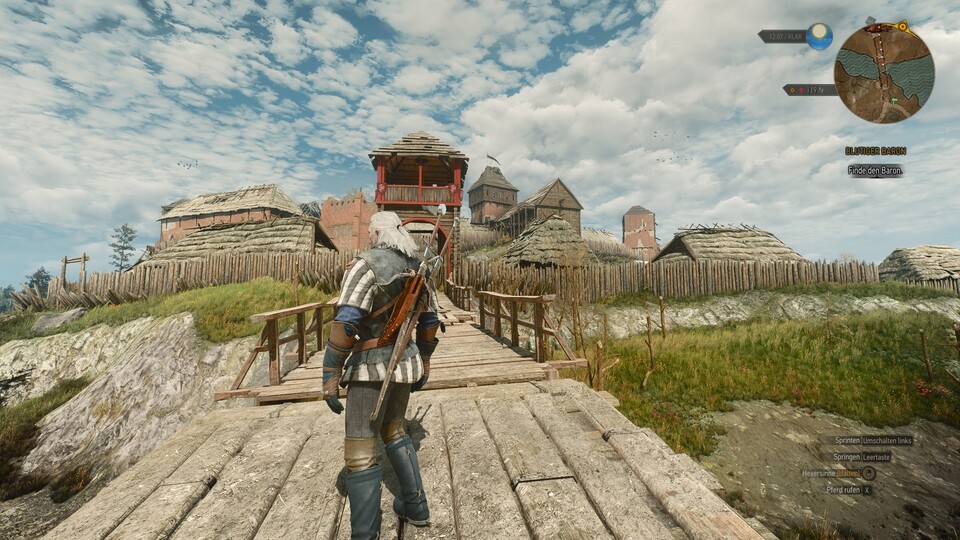
However, it’s clear that the game wasn’t originally developed with ray tracing in mind. While this creates a truly atmospheric lighting ambiance—especially in outdoor areas—and represents a real improvement over the original, indoor spaces with only a single light source are often far too dark. The background and room furnishings are completely lost in the shadows, which is why we can only recommend using ray tracing to a limited extent.
On PC, the ray-tracing mode with ray-traced reflections currently offers the best balance between performance and graphics.
On the Switch 2, the remaster runs similarly to Cyberpunk 2077, at 30 FPS on 60-hertz TVs and 40 FPS on 120-hertz TVs. However, the 40 frames per second cannot always be maintained, especially in busy areas like Novigrad. Additionally, the image appears blurry in a direct comparison. We cannot comment on the technical state of the Xbox and PlayStation versions at this time, as CD Projekt was unable to provide us with access to them in advance.
</b></p><p></p><p><iframe loading=)
Cyberpunk, is that you?
Among the few criticisms of the original Wild Hunt were the talent and combat systems. In the original Witcher 3, talents were, so to speak, unsorted in a five-tier grid on your character tab. You could start unlocking them wherever you wanted.
However, to reach higher talent levels, you had to invest a certain number of points into the respective block—that is, Combat, Signs, Alchemy, or General. This meant that many advanced skills couldn’t be unlocked until very late in the game. Additionally, you were limited to a maximum of 12 active talents at any given time.
The remaster retains the limit on active skills. You still combine them with appropriate mutagens on the right side of the skill window. However, with game version 5.0, there is now a proper skill tree. All abilities have a set unlock sequence and are logically interconnected. This allows you to develop Geralt in a much more targeted manner toward a specific direction—such as focusing on bleeding damage—and unlock the desired skills much earlier in the game. This makes building your character even more meaningful.
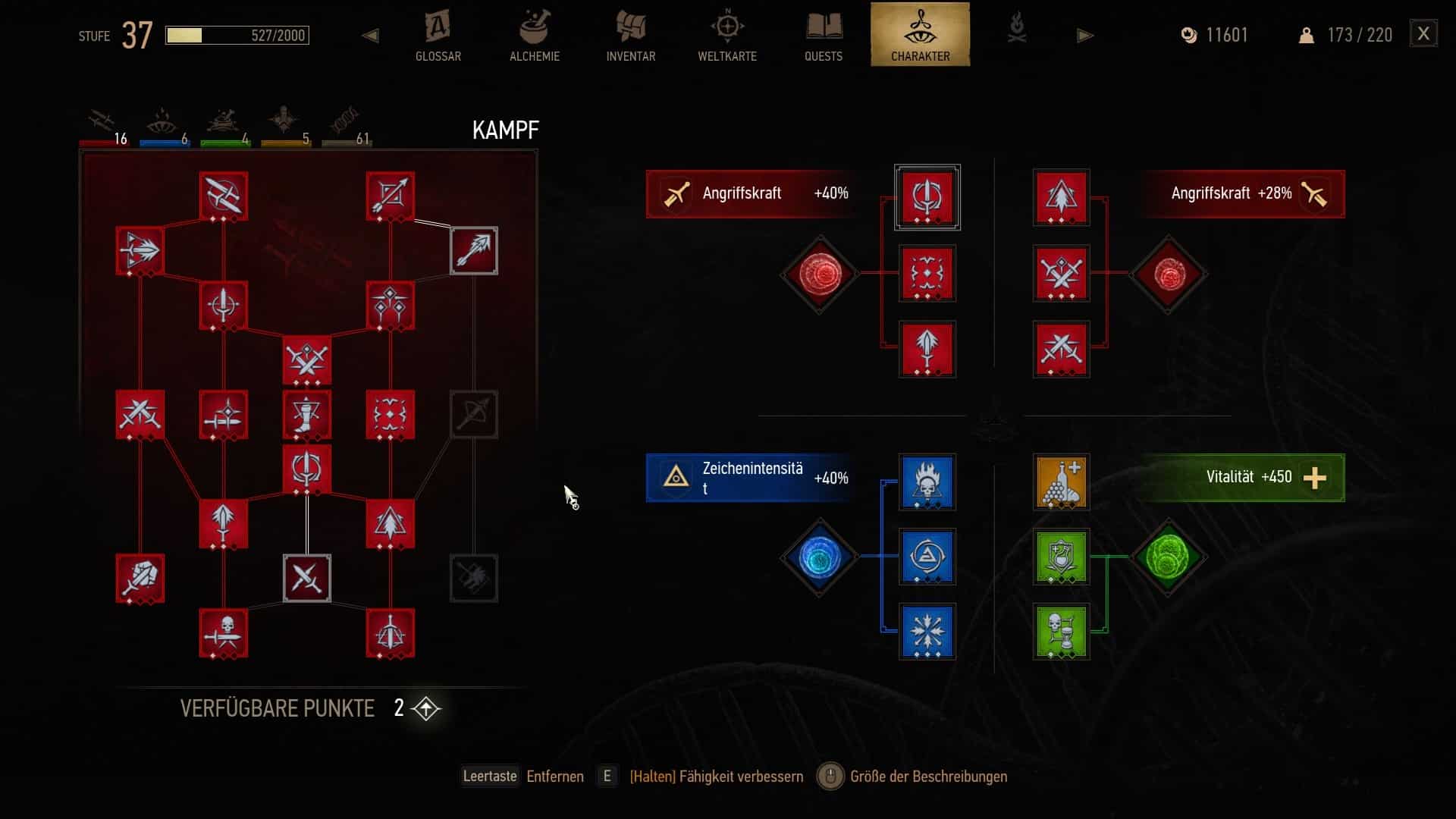
(The talents in the skill tree now have a fixed order and are connected to each other in a meaningful way.)
There are also a few brand-new skills that replace old ones—such as armor bonuses for virtually every known school of sorcery or enhanced elemental damage. The new system places much greater emphasis on strategically chaining attacks rather than simply boosting individual attacks as in the original game. Overall, the new talent tree functions similarly to the revamped character system from Cyberpunk 2077 2.0.
However, if you load an old Witcher save file into the remaster, you’ll hardly notice the new system, because right after loading, you’ll be given a bunch of skill points that you can use to immediately re-learn
your old skill level. So if you really want to develop Geralt in a way that makes a noticeable difference, you should start from scratch with the remaster. You might want to keep your old save files handy, though, in case of “Songs of the Past.”
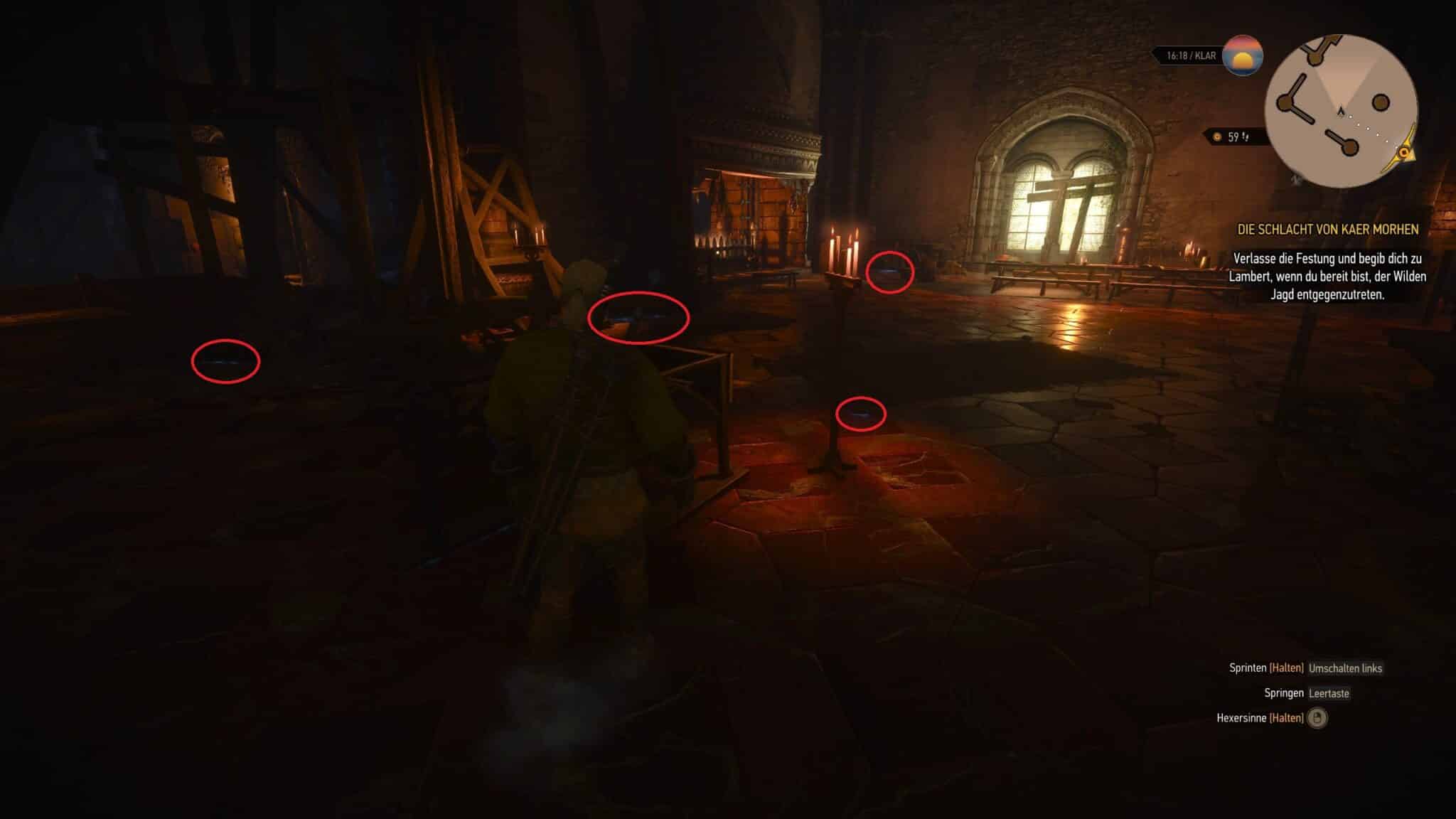
(When path tracing is activated, interiors are often far too dark. On some edges, it has a bluish shimmer.)
Missed Opportunity: Combat System
The improvements to the combat system primarily concern the animations. Geralt now moves much more fluidly around enemies, attacks flow better together, and there’s a whole range of new, bloody finishing moves. In the vanilla version of the third Witcher game, the attacks often still felt disjointed and slow. The remaster does a much better job of creating a genuine sword-fighting atmosphere.
However, the remaster doesn’t change the fundamental simplicity of the combat system. Geralt likes to get straight to the action. Duels are still essentially limited to alternating between light and heavy attacks, using Signs, and frequent dodging. In 2026, we would have liked to see a bit more here—for example, The Witcher 3 still doesn’t offer proper hit animations for enemies. And the new Silver Chain won’t be added to the game until next year with “Songs of the Past.”
(Geralt (here with Nvidia HairWorks) and Yennefer (without) are still the heart and soul of the remaster.)
The clarity of the combat has also been tweaked. The camera now zooms out further depending on the number of enemies to give us a better overall view. However, unlike the old standard perspective, this makes it harder—especially at the beginning—to target an enemy without activating lock-on. Geralt often ends up swinging at thin air. So even with the remaster, The Witcher 3 hasn’t become a truly intricate combat ballet.
Finally, meditating in style
But what else is included in The Witcher 3 Remastered? In addition to major changes to the visuals, skills, and combat system, the remaster includes many small detail improvements: Geralt now swings more smoothly over obstacles and up ladders; while meditating, the virtual world continues to run in the background in true-to-style fast-forward; and weapon wear—hated by RPG fans—can now be turned on and off in the menu.
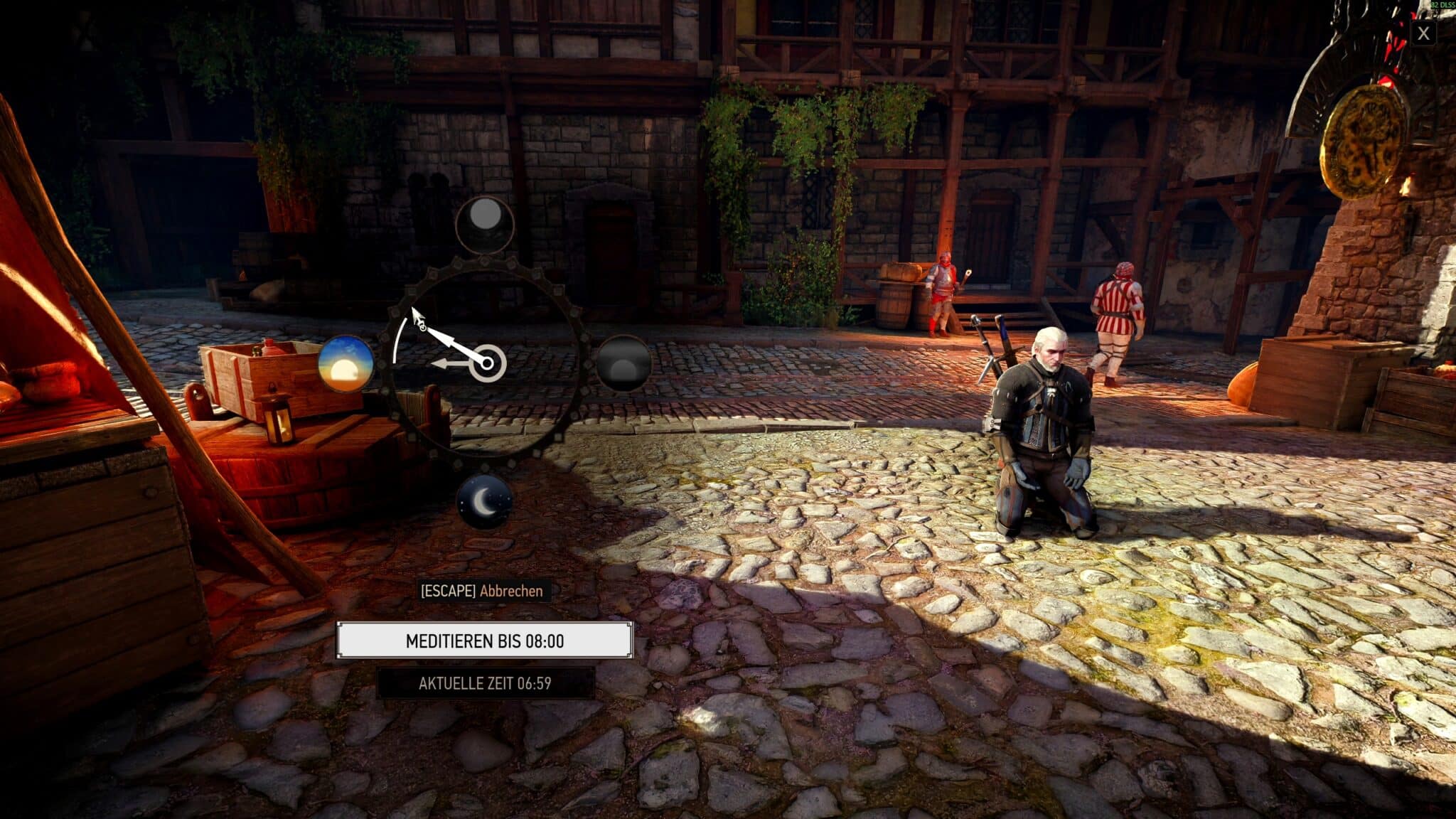
(When meditating, we no longer see a distracting menu in the remaster. Time continues to pass in the background.)
Speaking of weapons: You can now finally transmogrify weapons and armor at the blacksmiths in Novigrad and at Crow’s Nest Castle. If you find a new, stronger piece of armor that’s as ugly as sin compared to your previous plate armor, you can swap its appearance at Hattori and Yoana’s for a small fee. The visuals for casting signs have also been revamped. With Igni, the sparks now shoot out of Geralt’s hands even more beautifully. The Yrden sign glyph glows a vibrant purple on the ground.
What, on the other hand, is still utterly ridiculous in the remaster is our trusty steed, Plötze. Although the developers had actually promised significantly improved controls and pathfinding here—and we do indeed navigate curves a bit more smoothly—the bottom line is that the horse still gets stuck far too often and stands around at odd angles—so in a way, everything remains the same here.
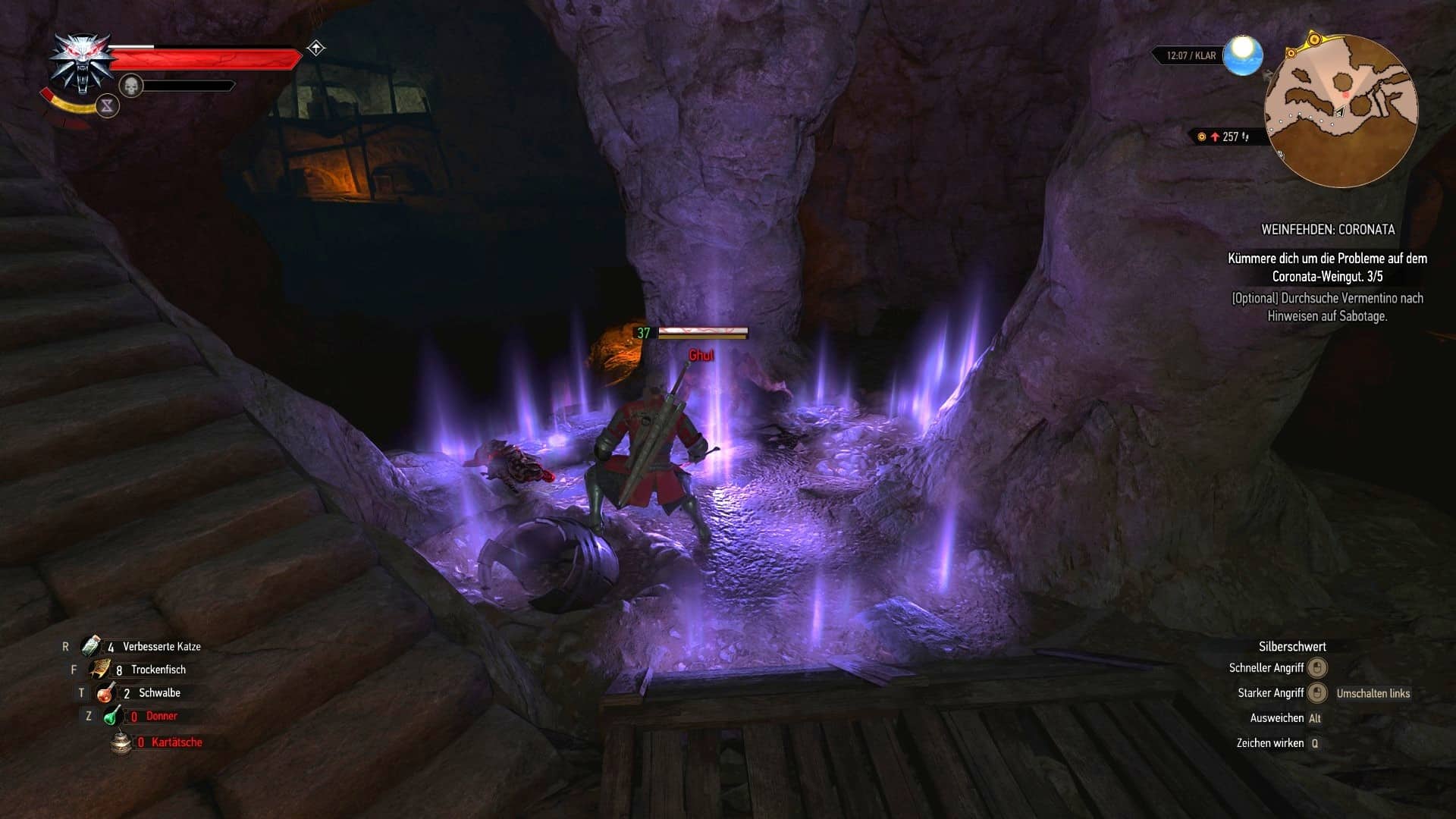
(The spell circle glyph Yrden and other Witcher marks now shimmer with rich detail)
That, however, is precisely one of the game’s greatest strengths. Even in the remastered version, The Witcher 3 still feels exactly the same as it did back then. When I load a random save file from somewhere in the middle of the game after launching the remaster and find myself in the wilderness of Skellige, it takes less than a minute for me to fall under the spell of the Witcher world all over again.
The music, the vast, rugged landscape—everything is exactly as I remember it and gives me that comforting feeling of coming home with the remaster. That’s exactly what The Witcher needed before the launch of a new expansion.
Editor’s Verdict
The Witcher 3 remains true to itself in this remastered version and is still damn good even in 2026. The hit RPG from 2015 appears here in its most visually appealing form, including the previously paid DLCs “Blood and Wine” and “Hearts of Stone.” At the same time, however, the remaster is exactly that and nothing more—a remaster. Anyone expecting a kind of remake might be disappointed, as the new edition refrains from making any profound changes.
Furthermore, not all of the remaster’s good ideas seem to have been fully thought through: The brand-new path tracing is all well and good in and of itself, but it currently often makes indoor areas too dark. Given the current market situation, very few players are likely to own a graphics card capable of natively running the game at 60 FPS or similarly smooth frame rates.
Yes, there’s now a skill tree and a slightly revamped combat system—but that doesn’t significantly change the overall feel of the game compared to previous versions. At the same time, of course, one has to wonder whether The Witcher 3 even needs this. After all, for me and many other fans, it’s been one of the best role-playing games in the world for years. It’s likely that no one on the development team really wanted to tamper with that concept.
The bottom line is that this remaster is a solid update that brings The Witcher 3 up to the technical standards of 2026. Is it worth playing through The Witcher 3 again just for that? Maybe only if you were already in the mood to revisit Geralt the Witcher anyway. Otherwise, with this free technical upgrade, the game is perfectly equipped for the launch of Songs of the Past next year.


