





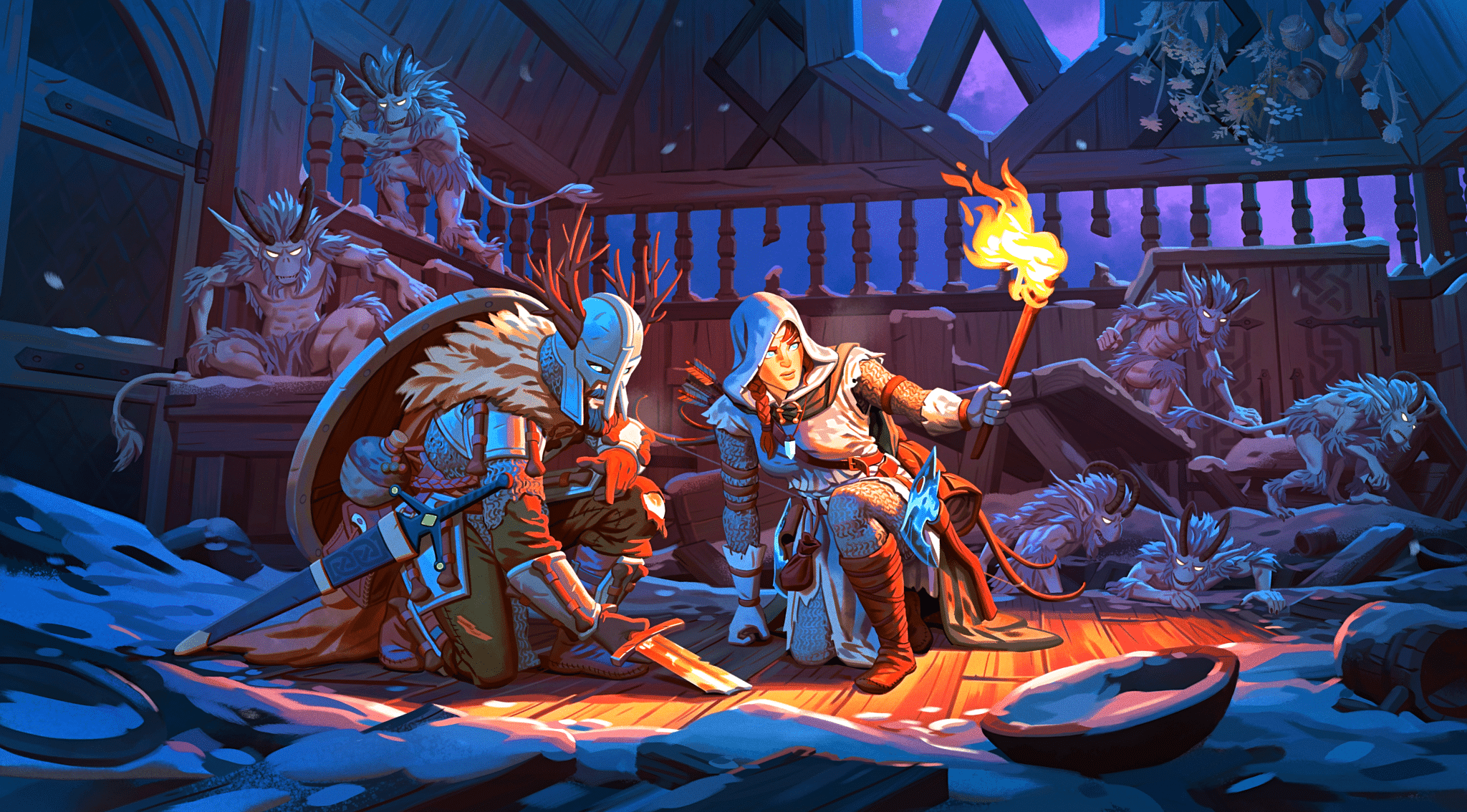
After more than five years in Early Access, Valheim is releasing Version 1.0, featuring a new biome, new materials—and old problems.
With Early Access titles, the period between the initial release and the full release is often described as a journey: The updates following launch are called milestones and serve as important beacons on the “roadmap” leading to the destination known as Version 1.0.
After more than five years in Early Access, Valheim is finally arriving at that destination. For the community and the developers, the time since February 2021 has felt like a wild ride. After the overwhelming launch, the Swedish studio Iron Gate only then realized the immense potential of their open-world crafting co-op formula. Following a hiatus in content updates and a hiring drive, the past few years have brought more biomes, recipes, materials, bosses, and mechanics.
And where better for Valheim’s almost magical journey to end than in the far north, covered in snow and ice? This final biome officially launches with Version 1.0 and proves to be a worthy conclusion to an immensely multifaceted adventure. On the following pages, we review the entire journey.
Table of Contents
Every beginning is cold. And wet.
In Valheim, we take on the role of a Norse warrior whom Odin’s Valkyries collect after an honorable death on the battlefield and bring to the so-called Tenth Realm, Valheim (more info in the box). This land has been beyond the All-Father’s influence for too long, allowing ever-stronger monsters to run rampant there. So, on behalf of the One-Eyed One, we restore order.


At first, however, we’re not fighting giant forest creatures or stinking piles of meat, but rather dealing with more mundane concerns: Where do I sleep? How do I stay warm? Unlike in Minecraft and similar games, we don’t build an entire estate in just a few clicks within the atmospheric, low-poly, postcard-perfect idyll, but instead take a much more incremental approach.
The Nine Worlds of Norse Mythology
In the Old Norse pantheon, the World Tree Yggdrasil connects all nine realms. In the crown of the tree, the gods dwell in Asgard, Vanaheim, and Alfheim. At the center lies Midgard, the home of humankind, surrounded by the icy realm of the giants, Jotunheim, and the blazing Muspelheim to the south. Deep underground lie the dark realms. In Schwarzalbenheim, the dwarves forge their treasures, while to the north, Niflheim is frozen in eternal ice and mist. At the very bottom lies Helheim, the silent realm of the dead ruled by the goddess Hel.

These mechanics are part of Valheim’s DNA; the game sticks with them all the way through, from workbenches to forges, and we’re introduced to them right from the start. After a bit of a learning curve at the beginning, however, you quickly get used to the quirks and plan accordingly for every house and outpost.
A Solid Story, Visually Stunning Presentation
In Valheim, there are nine biomes—including the ocean—that differ in terms of visuals, challenges, rewards, and enemies. In each biome of the procedurally generated world (except for the ocean), we encounter a boss feared by Odin, whom we must defeat before moving on to the next biome. Before the boss fights, we scour the biomes, discover new ores like bronze, iron, and silver, upgrade our equipment, and face the formidable foe fully equipped for the current biome.

This basically describes Valheim’s gameplay loop: arrive, explore the biome, upgrade gear, defeat the boss, move on—nine times in total—done. Story enthusiasts will enjoy the cryptic texts inscribed on rune stones about the world’s mythology and its former inhabitants. Additionally, Hugin and Munin, Odin’s faithful ravens, repeatedly appear with valuable tips on new areas and mechanics.
On the other hand, after every boss fight, we unlock an extremely cool cutscene that shows the recent battle from the perspective of a group of Vikings and hints at the path to the next biome. These clips stand out for their visually stunning and sometimes brutal anime-style presentation and serve the important function of guiding the player. Thanks to the cutscenes, we know exactly where our next destination is for story progression. Whether we actually go there, however, is left up to us.

The music follows in the same vein as the video clips, almost always striking the right note. From gentle melodies as we stroll through lush meadows to heavy metal sounds during thrilling boss battles, Valheim presents us with a wide spectrum of auditory delights.
Open World as the Ultimate Viking Experience
We realize after just a few hours that the gameplay loop mentioned above only holds true in theory. As soon as we start gathering wood, stones, and later tin and copper ore, bones, iron, and so much more, the unlocked recipes for structures and items start popping up all over the screen. Biome hunting and boss battles quickly fade into the background, and Valheim transforms into the ultimate romanticized Viking experience:


We convert our initial hut into a longhouse; outside, we build a pen for tamed wild boars, which are later joined by wolves and even moose. A little further away, we lay out garden beds for carrots, beets, and onions, because hanging over our fires is no longer just a simple meat grill—there are also soup cauldrons and mead fermenters.
In charcoal kilns, we burn wood into charcoal, which we feed into the smelting furnace along with mined raw ore. From the resulting ingots, we craft new armor and weapons at the forge, which we use to further claim the world as our own. Amid all this, the bees buzz and produce honey—and we’re only describing our main base here. The outposts in the various biomes are just as impressive.
On top of that, there are countless options for building: beams and roofs with various pitch angles, walls, fences, defensive structures, boats, and an insane number of decorative and ornamental elements. In the Far North, we’ll find, among other things, new recipes for 67-degree roofs and even a drawbridge.

Since every biome introduces new building materials and thus creates new construction possibilities, that’s where the true motivation for progressing through the game lies. Unlocking, building, and decorating in Valheim feel so incredibly rewarding throughout the entire gameplay experience that we’d rather put up with—rather than actively seek out—the sometimes brutally tough battles against enemies like skeletons, predators, dragons, Draugr, the new Gammeltrolls, and the bosses.
However, a structured approach to gameplay quickly becomes a necessity: For one thing, you shouldn’t rush through the biomes anyway; for another, it’s easy to lose track of things—especially toward the end—with all the unlocks in a single biome.
The Far North: The Final Biome
We’ll mention the new features of the game’s final section throughout the text, but we’ll avoid giving overly detailed descriptions to avoid spoilers. As in the other biomes, there’s a lot to discover—including, of course, new equipment sets. Plus, Valheim pulls out all the stops for the finale by letting us trudge through deep snow and explore snow-covered villages.
Full Potential Only in Co-op
Up to ten players can run wild on a single map. To do this, we can either open our solo worlds to outside players or rent dedicated servers directly. Anyone who sees Valheim as a shared adventure and a hero’s journey will benefit immensely from the co-op aspect.


We can only level the ground and make it fertile in a circular layout. Rectangular beds always result in a visual overhang. The list on the right gets longer and more confusing as the game progresses. Also, we always need to have all crafting materials on hand. Storing them in the crate on the left doesn’t count.
Exploration, specializing in melee and ranged combat—and later, magic—as well as experimenting with different weapon types like swords, axes, clubs, spears, bows, and crossbows, along with various damage types that are crucial due to enemy resistances, is incredibly fun to do as a group.
Furthermore, Valheim conveys a sense of peaceful camaraderie in an almost unique way. It’s simply a joy to expand and decorate our main base or the outposts in the various biomes, explore the map by raft or longboat, or simply sneak through the forest armed with just a bow and arrow to hunt deer.
In none of these moments do you get even the slightest feeling that you’re missing out on anything. On the contrary: a deliberate slowdown is an integral part of Valheim’s game philosophy.
Pleasantly Forgiving Survival Mechanics
Anyone who dismisses Valheim as merely “cozy” will have to reconsider once the later battles roll around. In the first two biomes—the meadows and the Dark Forest—that may still be true. But in the swamp, the mountains, and the plains, battles and enemies gradually become more challenging.

The Mistlands, the Ashlands, and finally the Far North are part of the endgame area. By this point at the very latest, you should be familiar with combat styles, equipment bonuses, food buffs, and enemy weak points. Just like in an action-adventure game, the open world—with its dungeons, abandoned villages, and hidden chests—offers great potential for discovery and rewards.
Valheim rightfully belongs in the survival game genre, though it features a pleasant set of mechanics. In addition to the health bar, our character has a stamina bar. We run out of breath when sprinting, jumping, building, weeding, leveling ground, fighting, and swimming. If enemies attack us or we take damage in other ways, our health points decrease.
However, we don’t starve if we don’t eat. Instead, food simply boosts our health: From simple grilled meat to bread, pies, and even köttbullar, Valheim offers a huge selection of food. We prepare these dishes at various cooking stations, upgrades, and ovens. All of this contributes immensely to the overall sense of well-being and the feeling of village life.

However, just like the many different types of mead, food also offers tangible benefits. Each dish provides a buff to either health points, stamina, or, to a lesser extent, both. Because the right meals can boost health and stamina to sometimes dizzying heights, selecting and combining the right three meals that can be eaten simultaneously contributes at least as much to combat success as weapons and armor.


We also dodge attacks by rolling and then strike from the flank. This works well in most cases. Sometimes, however, enemies make our combat tactics more difficult due to animations that are hard to read. We level up our combat skills, as well as our crafting and athletics skills, across 20 categories based on the “learning by doing” principle from Skyrim.
Anyone who sees Valheim primarily as a building and exploration game set in a Viking world may be surprised by its pleasantly complex combat system.
Comfort is not a Norse deity!
With Version 1.0, Valheim gets a lot right and delivers a complex and satisfying conclusion. However, missing convenience features—for which, in our view, there has been no explanation for years—carry over into the final release.
Starting with the inventory: Our virtual bag has 32 item slots. Of these, we place eight weapons and tools on the quick-access bar, which can be selected with the press of a button. Why the 9 and 0 keys aren’t also available to us remains a mystery to Iron Gate. Since we typically carry a sword, shield, bow, arrow, axe, pickaxe, and armor consisting of a helmet, chest guard, leg guards, and cloak, as well as a belt and a biome-specific tool, twelve slots are already taken even when our “inventory is empty.” Healing potions and food are added to that.

This makes exploring unknown enemy territory unnecessarily fiddly. Later in the game, Haldor, the merchant in the Dark Forest, sells larger bags. These give us eight additional slots, but they don’t solve the problem. There’s also no sorting function.
At the workbench or forges, we miss having a useful way to sort the recipes we’ve unlocked so far. Especially as we approach the endgame, we’d like to see a list of the countless items organized by biome, so we can select specific items instead of scrolling endlessly. When crafting, cooking, or forging, we always have to have the ingredients in our inventory. If they’re in a chest right next to us, we can’t craft. The further we progress in the game, the more annoying this gets.
We also miss a loot filter: if there’s space in the inventory, our character picks up items off the ground. At some point, though, we no longer want to loot every early-game gray dwarf we kill, but we end up doing so anyway. The result: tedious sorting of small items.
The lack of a loot filter also has tangible drawbacks: If we kill a wandering minion monster in the middle of a boss fight and collect a metal item from it, we can no longer flee through the saving portal when our health is critically low. In the default settings, metals prevent teleportation—regardless of whether they were collected intentionally or by chance.
Leveling the ground with a pickaxe is also more cumbersome than necessary in 1.0: While it’s relatively easy to adjust surfaces to a specific height with a bit of fiddling, creating paths for the handcart becomes a nightmare, especially when dealing with elevation changes. There have long been better solutions for this, such as the PlanBuild mod.
World Modifiers for the Perfect Game
In recent months, however, there have also been improvements in terms of convenience. Before each session, we modify our world’s gameplay rules to suit our preferences. We set how challenging we want combat to be, whether we lose skill points and equipment upon death, whether we receive triple the amount of resources when mining, whether our base will be raided by enemies, whether we’re allowed to take ores through portals, and much more.
Solo builders and daring lone wolves, in particular, can create their perfect game and tailor their challenges entirely to their own preferences. And that’s exactly where the greatest strength of this Viking open-world sandbox shines through: The game gives us possibilities and tools—we use them to make it our very own experience. Even more so than ever before.
Editor’s Verdict
For more than five years, I’ve been falling into Valheim’s “just one more” trap: just one more animal to tame, just one more raw ore to smelt, just one more building phase to finish, and just one more boss to take down. Rarely has a game hit all the right notes for me quite as precisely as Iron Gate’s hit.
And the idyllic atmosphere and detailed visuals are just the icing on the cake. What wins me over most of all are the game mechanics and the creative possibilities: I go on thrilling adventures with friends, venture alone through the forest to hunt deer, sail across the ocean hoping the sea serpent doesn’t eat me, or lose myself for hours building a new outdoor area for my longhouse.
And even though I don’t play Valheim primarily for the combat, I do find it quite fun—partly because of the tactical depth provided by weapon types and the food system. In the default settings, though, the enemies become too powerful in the final third of the game. That’s why I’m especially happy about the useful world modifiers.
After more than 500 hours, I still don’t see an end in sight.


