





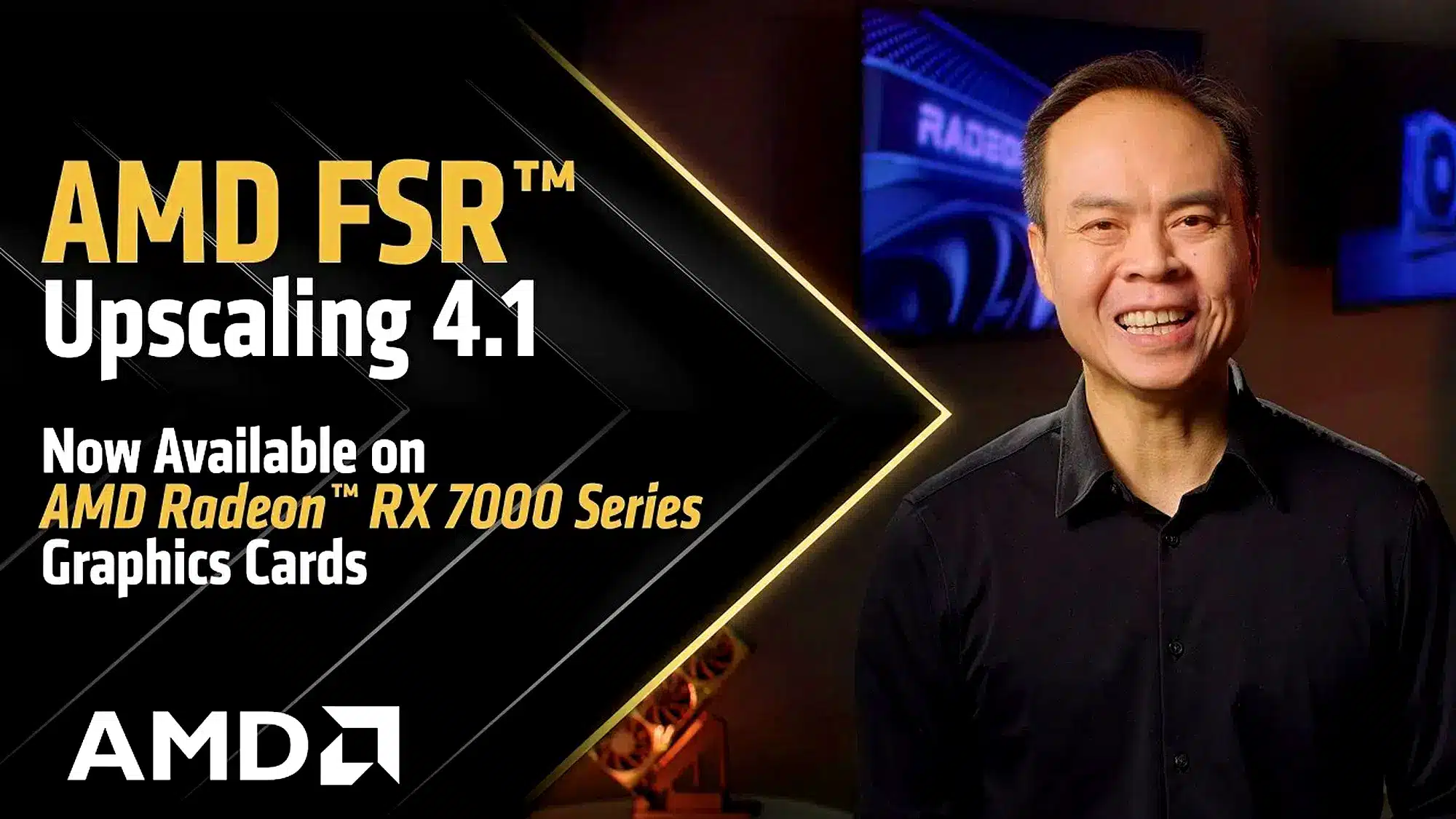
AMD has released FSR 4.1 with the Adrenalin 26.6.2 driver for all discrete Radeon RX 7000 graphics cards—about a month earlier than originally announced.
AMD has released the AI-powered upscaling technology FSR 4.1 (FidelityFX Super Resolution)—which previously ran exclusively on RDNA 4 cards in the RX 9000 series—for all discrete graphics cards in the Radeon RX 7000 series with the new Adrenalin driver 26.6.2.
The download is available now. AMD had originally announced July 2026 as the release date for Radeon RX 7000 cards.
FSR 4 on RX 7000: Over 300 Compatible Games
According to AMD, FSR 4.1 has been tested on hundreds of PC configurations, ranging from the entry-level RX 7600 to the RX 7900 XTX. More than 300 games already support FSR 4.1.
According to AMD, the official port is also expected to perform better than the community mod that emerged after the DLL leak in September 2025—particularly in terms of detail reconstruction.
- Since RDNA 3 graphics cards cannot efficiently perform the FP8 calculations that RDNA 4 chips are designed for, AMD is relying on INT8 for the RX 7000 port.
- According to AMD, the image quality is close to what buyers of an RX 9000 card with native FSR 4.1 are accustomed to—though AMD explicitly states that it is not fully equivalent.
APUs are an exception, however: According to AMD, the company is still working on streamlined AI models for integrated graphics units based on the RDNA-3 and RDNA-3.5 architectures that can operate with lower computational and memory bandwidth.
The same applies to the recently announced Steam Machine, whose custom AMD APU still has to make do with FSR 3.1.
According to earlier benchmarks fromComputerBaseshows that switching from FSR 3.1 to FSR 4.1 on a Radeon RX 7900 XTX at the same upsampling level results in approximately 16 percent more GPU load. On RDNA 4 cards, this figure is around 8 percent.
However, according to the same test, this additional load is put into perspective: The leap in quality is said to be so significant that FSR 4.1 consistently outperforms FSR 3.1 Quality. And that was “only” tested via the unofficial workaround—so there’s good reason to hope that AMD’s official FSR 4 release for older GPUs will perform even better.


