





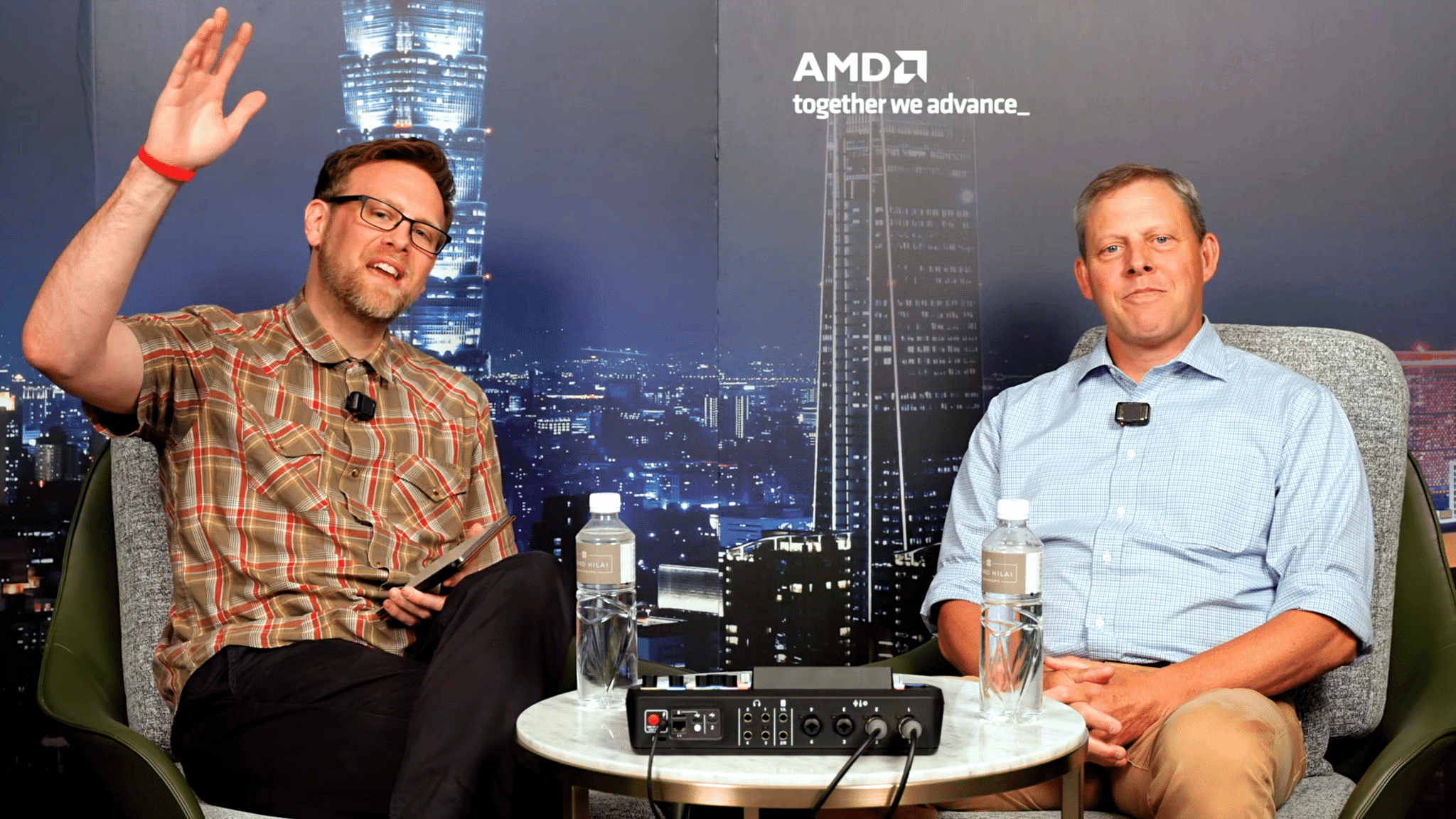
AMD executive David McAfee views NVIDIA’s RTX Spark as clear validation of an existing architecture—and suggests that “Unified Memory” will become more prevalent across platforms in the future than it has been to date.
For years, VRAM and system RAM were considered two separate worlds in the PC: The GPU got its dedicated video memory, the CPU its main memory—and data flowed sluggishly between the two via the PCIe bus.
AMD has challenged this coexistence with the (still) current generation centered around the Ryzen AI Max 300 (“Strix Halo”). The SoC uses a shared memory pool for both processing units. AMD has named the concept “Unified Memory Architecture« (UMA).
At Computex 2026, Nvidia followed suit: With “RTX Spark,” the company unveiled its first proprietary UMA system, which dynamically allocates memory between the CPU and GPU depending on the workload. AMD manager David McAfee commented on this during a press Q&A session (viawccftech) – and left no doubt as to how AMD views this move.
Nvidia as confirmation, not as a challenge
According to the head of AMD’s Ryzen and Radeon divisions, Nvidia’s announcement should be seen as a tailwind: More vendors mean more software support, more driver optimizations, and more pressure on operating systems to properly support UMA architectures.
What Nvidia has done with its announcement is to validate this architecture—that they, too, see it as the right solution for such systems.
When asked whether gaming CPUs or desktop systems might also receive such shared memory in the future, McAfee remained vague: He simply does not know which direction the concept will take in the coming years. However, he is confident that the unified memory architecture opens up a “world of possibilities.”
Ryzen AI MAX 400: 192 GB, 300-billion-parameter models locally
While McAfee remained vague on the desktop question, the next step for UMA is already concrete: The “Ryzen AI MAX 400” series is expected to offer up to 192 GB of unified memory—of which up to 160 GB is exclusively for the GPU.
According to AMD, this would allow language models with more than 300 billion parameters to be run locally. By comparison, the predecessor, Ryzen AI MAX 300, offers up to 128 GB, of which a maximum of 112 GB is allocated to the integrated GPU.


