





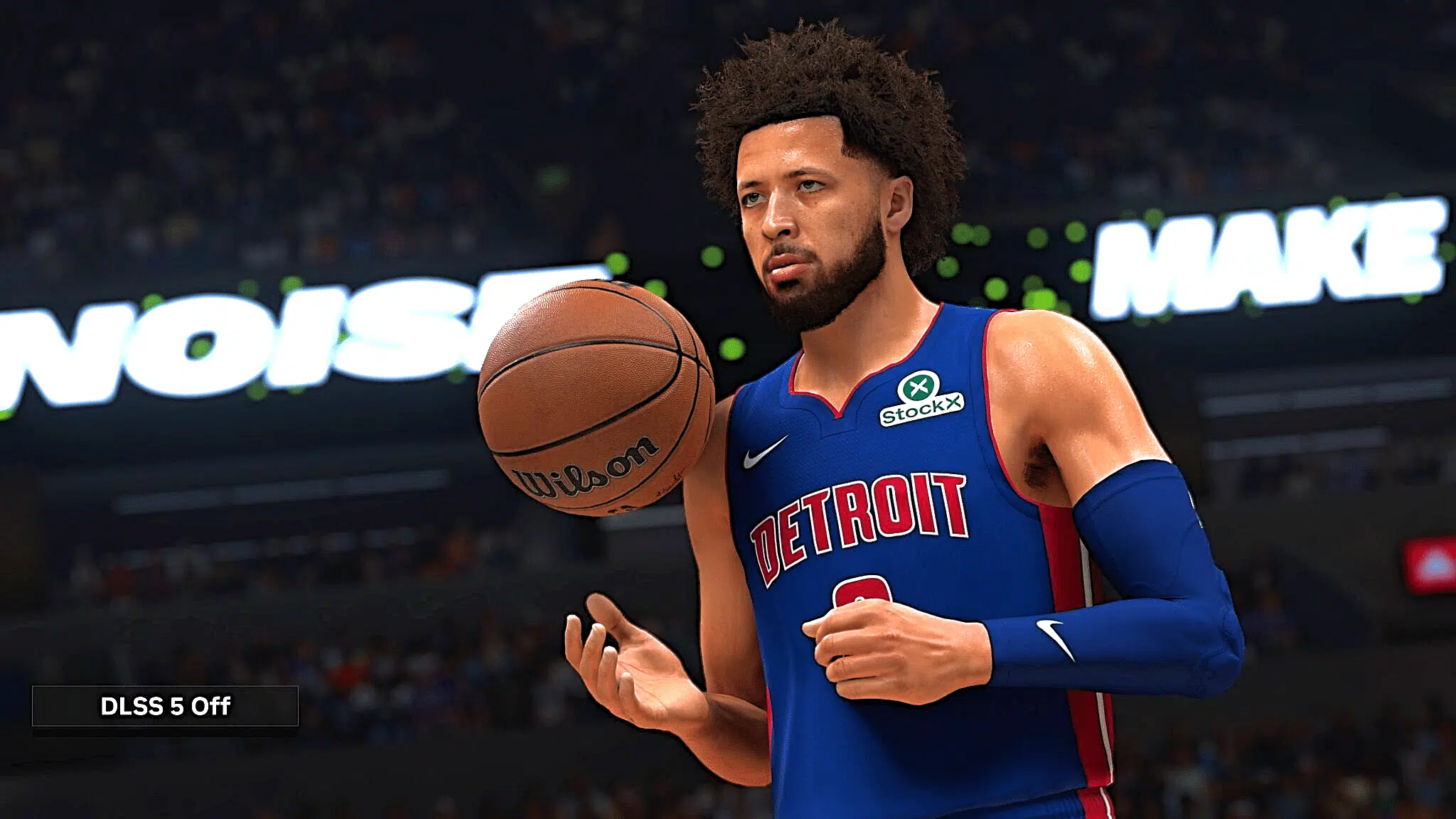
DLSS 5 doesn’t deliver more frames; instead, it consumes up to 70 percent of performance. In return, Nvidia’s new technology eliminates the “plastic” look in games.
When people think of DLSS, they usually associate it with one thing above all else: more frames per second.
But with DLSS 5Nvidia is, in a sense, turning that on its head. If you will, everything DLSS stood for up until now was merely a prelude to DLSS 5.
In NBA 2K27, the new technology comes at a massive performance cost on our GeForce RTX 5080 Founders Edition. However, it noticeably improves the realism of people and materials.
DLSS 5 Has a Greater Impact on the Image
The latest iteration of Deep Learning Super Sampling focuses on what’s known as3D-Guided Neural Rendering. This technology accesses data from the respective game engine to refine skin, hair, lighting, contact shadows, and materials using a neural model.
Geometry and basic structure are preserved. 3D-Guided Neural Rendering operates as the final step in the rendering pipeline, working with the generated frame and data from the engine.

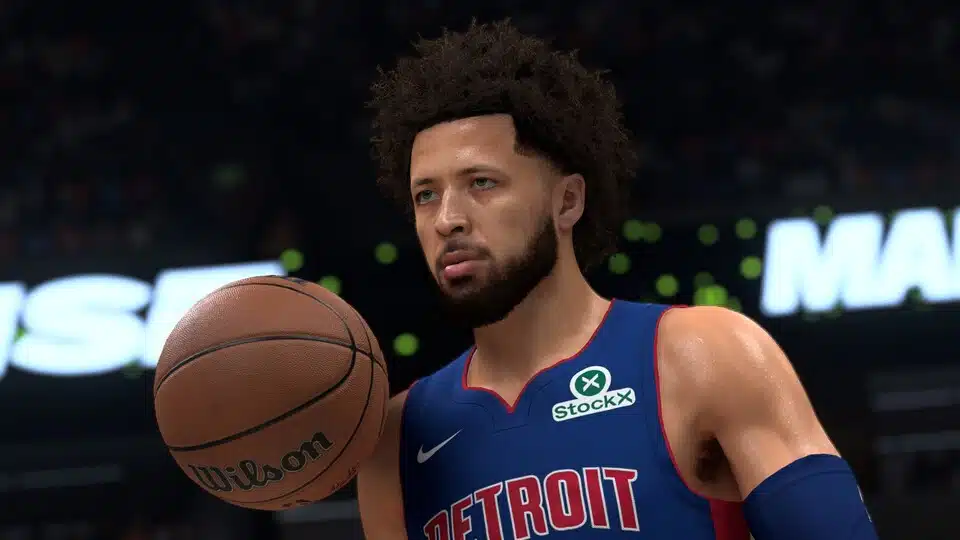
As a result, faces appear significantly more realistic and three-dimensional, especially in close-ups. Skin reacts more believably to the hall lighting, beards and hair gain more depth, so to speak—and different fabrics can be distinguished from one another more easily.
That’s not to say, however, that NBA 2K27 looks bad without Neural Rendering. It doesn’t. It’s just that, in a direct comparison, the slightlywaxy
look that’s often typical of characters stands out more.
From the normal, slightly elevated angle, the difference is correspondingly less noticeable than in replays, cutscenes, and close-ups.
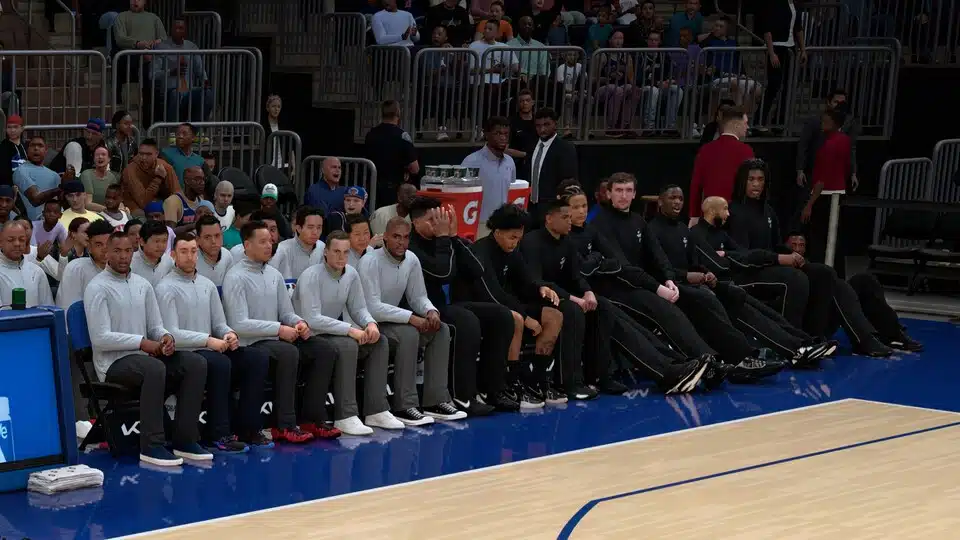
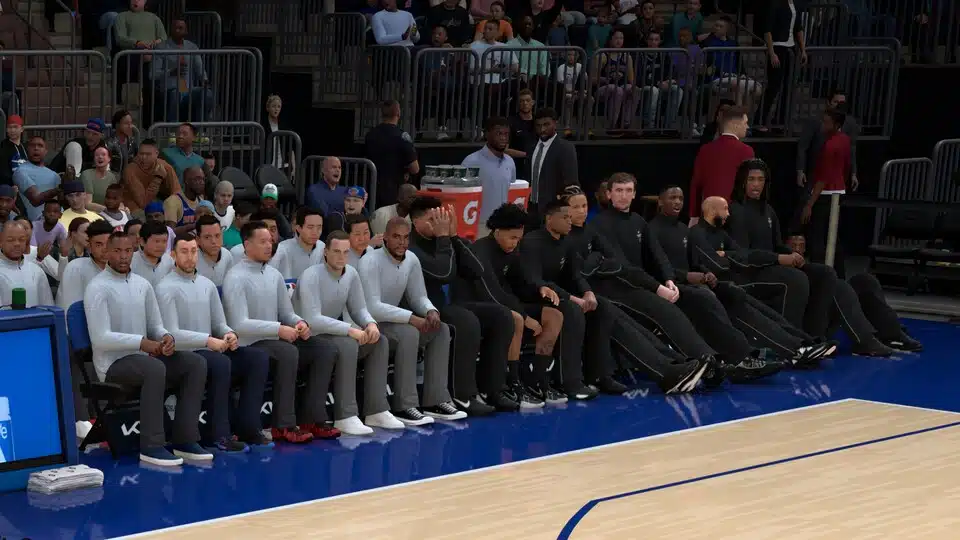
But even there, you can still see it. Even the spectators appear more vivid and three-dimensional.
The cost of this is enormous
Without Neural Rendering, our RTX 5080 averages 171.5 FPS in 4K, with the Ultra preset and ray tracing maxed out, while DLSS Super Resolution is enabled in Quality mode.
If we enable the new technology, that drops to 53 frames per second. Not to mention the one percent of the lowest FPS values, which drop to just 39.2 FPS in this scenario.
But as mentioned earlier, DLSS 5 didn’t just suddenly fall from the sky. Over the years, Nvidia has developed and refined a hodgepodge of techniques designed to plug this gap.
On our RTX 5080, in addition to DLSS Super Resolution in Quality mode, double Multi-Frame Generation is enough to boost the average frame rate from 53 to 94.9. We didn’t notice any image artifacts.
Without Neural Rendering, we even measure 268 FPS.
The performance loss therefore remains massive—in the range of about minus 65 to minus 70 percent.One possible reason for this could be the large number of spectators and the field players. But that is pure speculation for now, and it remains to be seen.
Nvidia Trades Performance for Credibility
And that is precisely where the interesting development lies—the direction Nvidia is taking with DLSS 5.
When Nvidia introduced DLSS in 2018 and rolled it out in early 2019—including inBattlefield 5—the early versions still struggled with blurry textures and noticeable quality issues. But Nvidia quickly improved the technology, continued to develop it, and over several generations, it became the go-to tool for high resolutions and ray tracing.
This was followed by Frame Generation, Ray Reconstruction, Multi-Frame Generation (MFG), and—in parallel with the latter—a new AI model for Super Resolution, Ray Reconstruction, and DLAA. Just a few months ago, the second iteration of the Transformer generation was released, along with Dynamic MFG and MFG 6X.
With DLSS 5, this toolkit is expanded to include a tool that no longer reconstructs or generates intermediate frames, but instead plays a major role in shaping the final image content.
However, the performance cost for this is currently still very high.
NBA 2K27 has enough performance headroom to offset the performance drop with DLSS Super Resolution and Multi Frame Generation.
Whether this works just as well in games that are already more GPU-limited cannot yet be answered with any certainty. However, mods that have already implemented Neural Rendering in various games provide some clues.
Especially in older games, early mods sometimes show strikingly significant changes. At the same time, the game’s age can be an advantage when it comes to performance headroom.
It remains to be seen, however, whether the performance loss will become an issue in other games and other implementations.
Overall, though, NBA 2K27 illustrates quite well the direction in which Nvidia intends to develop real-time rendering in the coming years.


