





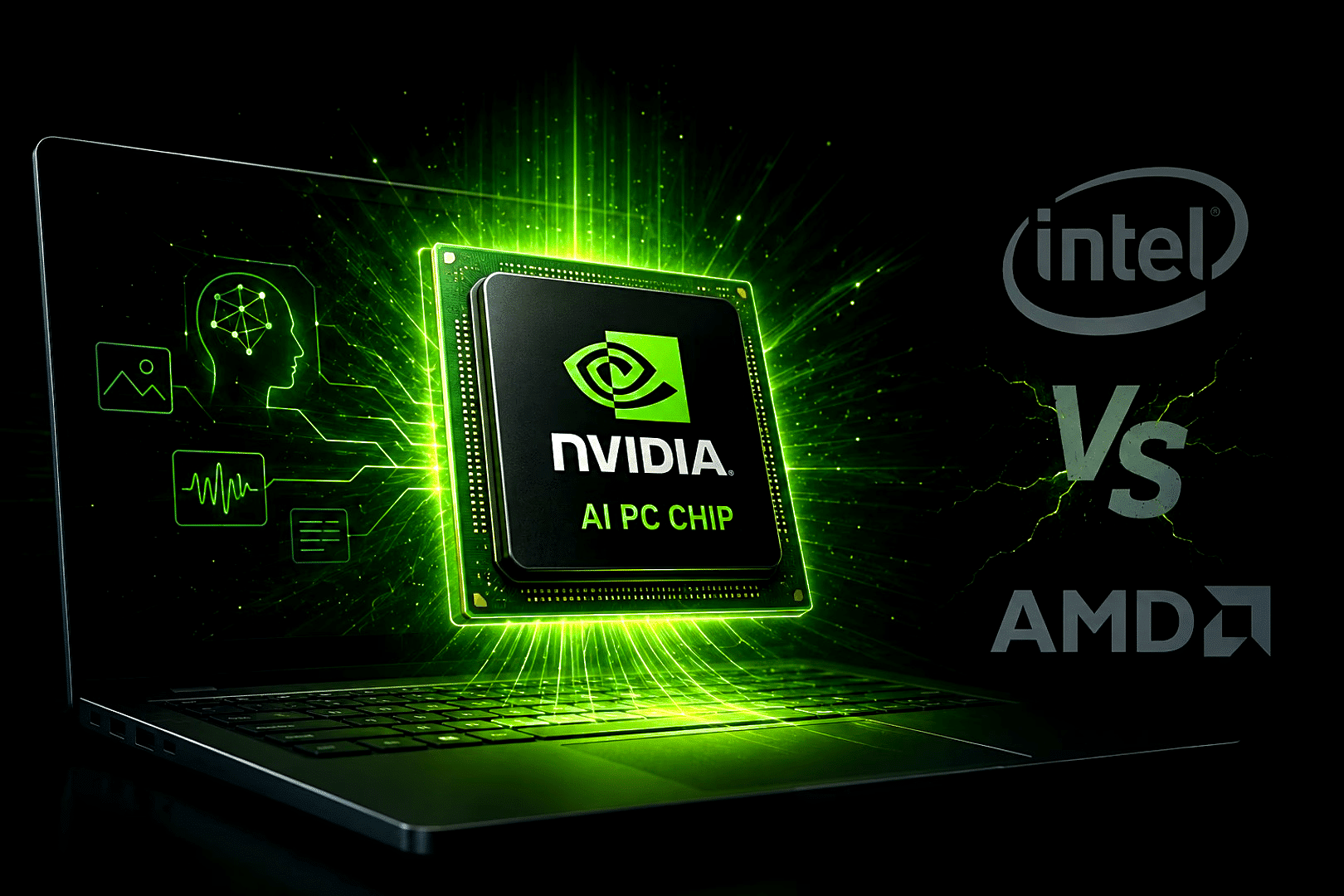
The new Nvidia RTX Spark chip breaks with traditional designs and relies on ARM. Can it revolutionize the Windows ecosystem?
Nvidia’s RTX Spark chip, freshly unveiled at Computex, marks a true paradigm shift. After the company had already cautiously tested the waters with its professional developer offshoot, the DGX Spark, Nvidia is now launching a major assault on the classic Windows ecosystem with the consumer model this fall. In doing so, the company is positioning itself directly against the x86 competition, which consists primarily of AMD and Intel. It is also seeking to take on Qualcomm, the only relevant provider of ARM processors for Windows devices to date.
The Architecture
Nvidia is breaking with the classic PC design (separate CPU and dedicated graphics card) and is relying on a highly integrated ARM-based system-on-a-chip (SoC), which is manufactured in collaboration with MediaTek using TSMC’s 3 nm process.
- Processor & Graphics:In its full configuration, the chip delivers a 20-core Grace CPU paired with a Blackwell RTX GPU (6,144 CUDA cores).
- Memory:Instead of separate VRAM and RAM, the system uses up to 128 GB of unified memory (LPDDR5X). The CPU and GPU share the memory directly with a bandwidth of approximately 300 GB/s. This eliminates the classic bottleneck in data transfer. The principle is already familiar from Apple’s M-series processors.
- The performance crown:Initial synthetic CPU benchmarksshow that the Spark chip can outperform Apple’s standard M5 chip by a solid 54 percent and ranks just behind Intel’s Core Ultra 9 285HX. As mentioned, this is a synthetic benchmark; the performance of
real-world programs
could paint a different picture. Outliers in either direction are possible.