






Mega DDoS attack on the entire gaming world: The notorious botnet Aisuru is believed to be behind the massive disruptions to Steam, LoL, Xbox, and PlayStation.
Millions of PC gamers were left staring at a black screen or were kicked out of their games last night. The globally popular gaming platform Steam was down for about an hour. This was a nuisance for anyone who wanted to log in after work, buy a new game, or start playing with friends. However, the problem was not limited to Valve’s service, but had far-reaching consequences.
The synchronicity of the outage at Steam and numerous other heavyweights in the industry has led experts to suspect a broader attack . Evidence of a so-called denial-of-service attack, or DDoS for short, is mounting.
This type of attack aims to bring servers to their knees with massive, artificially generated requests. The suspected background and extent of the disruption point to a new dimension of cyberattacks. We bring you all the known details about yesterday’s mega-attack.
Steam offline: What happened?
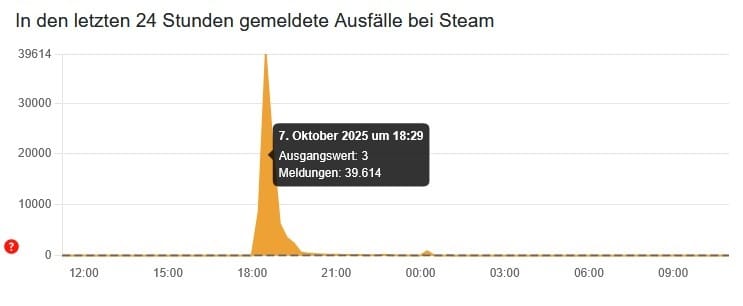
The Steam outage began at around 6:30 p.m. German time. For about an hour, users were unable to access the store, the Steam Community, or the service’s web API. Anyone who tried to log in or download content was met with error messages, even though the user interface itself was still visible.
The extent of the outage was enormous, as evidenced by the rapidly increasing number of fault reports on platforms such as Allestörungen.de. Even Valve’s own major titles such as Counter-Strike 2 or the currently in-development Deadlock were affected by the malfunctioning interfaces.
What makes this incident so explosive is the fact that Steam was by no means the only service affected. At the same time, other central hubs of the gaming world also reported massive problems, including:
- the servers of Riot Games, which operate games such as League of Legends and Valorant
- Sony’s PlayStation Network
- Microsoft’s Xbox services
- Epic Games with Fortnite
- the online services of Electronic Arts
This almost synchronous accumulation of problems suggests that this was a coordinated attack.
The trail leads to the Aisuru botnet
Security experts suspect that a large-scale DDoS attack was behind the disruption. A Canadian service provider specializing in defending Minecraft servers reported that a so-called TCP carpet bomb attack was launched at exactly 7:15 p.m. German time. This method aims to imitate gigantic data traffic and overload the attacked networks.
The origin of the attack is believed to be a botnet called Aisuru. Botnets consist of countless hacked Internet of Things (IoT) devices, such as surveillance cameras or smart home appliances, which are remotely controlled and misused for cyber attacks.
Steam and Riot Games are currently facing large DDoS attacks. TCPShield reports that they are also dealing with TCP Carpet Bomb attacks on their network. Word on the street is that it’s the same AISURU botnet that hit 29.69 tpbs today. pic.twitter.com/ofK0T19sze
— vxdb (@vxdb) October 7, 2025
Aisuru is not unknown. Back in September, this botnet was reportedly responsible for a hyper-volumetric DDoS attack that, according to Cloudflare, was twice as large as anything previously seen on the internet. These devices generate huge amounts of fake traffic to cripple their targets.
Riot Games confirmed issues
Riot Games acknowledged the network issues in conversation with PCGamer.com. A spokesperson for the company confirmed that teams have been working for some time to resolve outages affecting their games. The company has taken proactive measures to protect the gaming experience, such as temporarily disabling ranked queues in some regions. However, Riot declined to speculate on the exact cause of the disruption. The synchronicity of the outages among the major players speaks for itself.
We can only speculate about the attackers’ motives at this point. The most common assumption is that it was simply a show of force. An attack of this magnitude against such resilient and large targets can serve as a kind of proof of capability, possibly with the aim of selling the attack service to others. Such attacks are often a showcase for the providers.
Despite the short-term problems with Steam, which fortunately were resolved after an hour, and the ongoing challenges with other services, the events highlight the fragility of digital infrastructure.


