





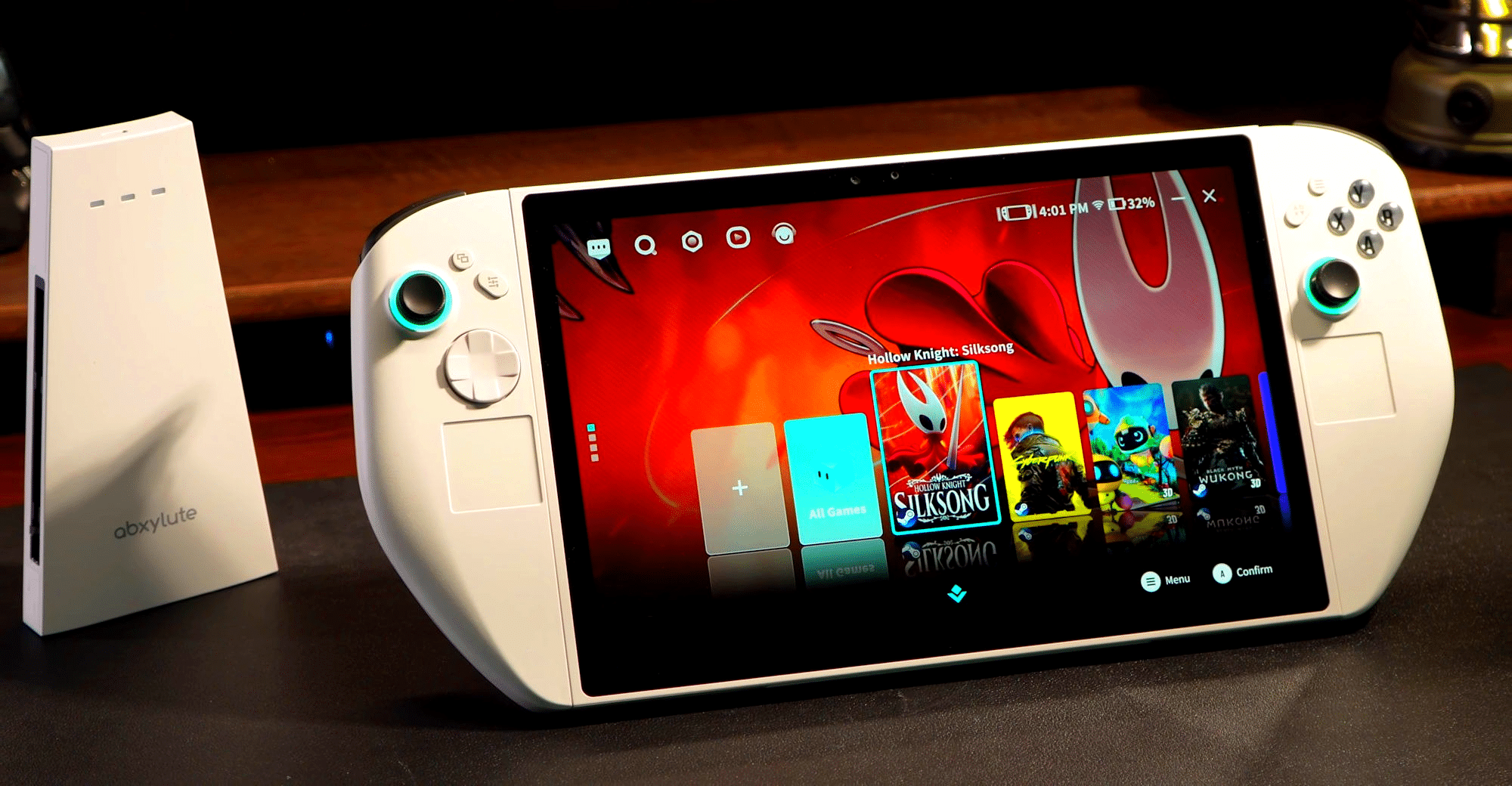
There has never been a handheld like this before, but would you be willing to pay a high price for it?
There is currently a heated discussion in the handheld community about a new device that stands out in many ways – and its glasses-free 3D screen is just one of its many special features.
The Abxylute 3D One is set to be delivered to its first buyers later this year – and although I’m very excited about the device, I’m already finding it difficult to recommend it.
Abxylute 3D One: The highlights at a glance
The 3D screen: The eponymous feature that makes this handheld so special is its 11-inch 3D screen with AI eye tracking. This not only makes the 3D effect possible without glasses, but also from different viewing angles. The front camera continuously detects the position of your eyes and adjusts the 3D effect accordingly.
According to the manufacturer, some games have even been optimized specifically for 3D display, such as Baldur’s Gate 3, Metaphor: ReFantazio, and Lies of P. Additional content can be converted from 2D to 3D using a physical switch.
Detachable controllers: As with the Nintendo Switch 2 or the Lenovo Legion Go 2, the controllers can be detached and used wirelessly. With a size like this, that makes a lot of sense, because you can simply place the handheld on the table as a kickstand and don’t necessarily have to hold it in your hands.
Can also be used as a laptop or tablet: Once the controllers are detached, the Abxylute 3D One becomes an 11-inch Windows tablet that even allows you to view 3D content. With a connected keyboard, it becomes a compact notebook.
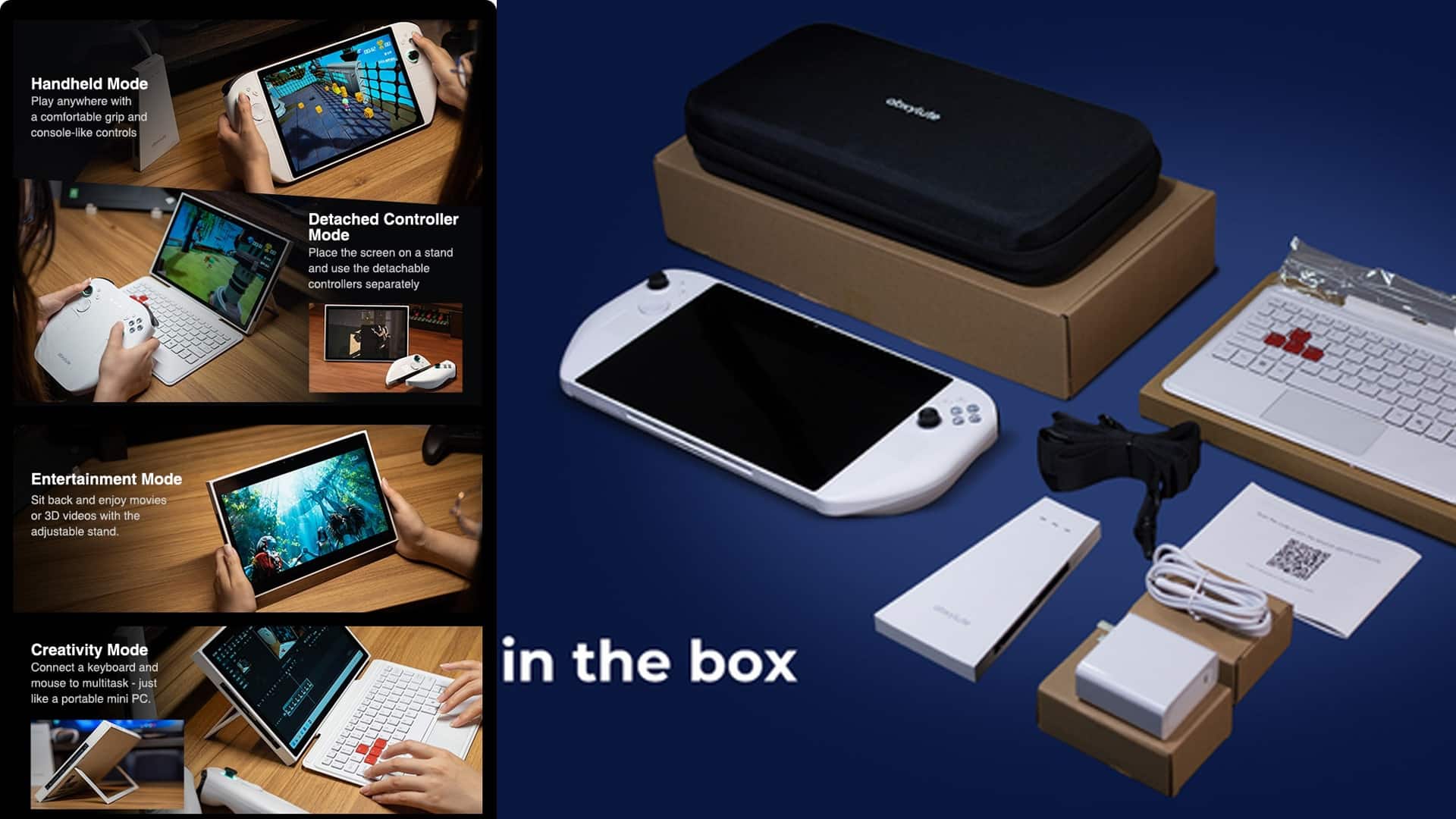
Dual trackpads: Two trackpads are far from standard on handhelds, but they should be. As with the Steam Deck, there is a small square trackpad on each side of the device. This allows you to play games that are usually controlled with a mouse.
High gaming performance: Inside, the Intel Core Ultra 7 258V powers the device. It has 32 GB of RAM at its disposal. This configuration already impressed me in the MSI Claw 8 AI+. Even compared to the new AMD Ryzen Z2 Extreme handhelds (Asus ROG Xbox Ally X and Lenovo Legion Go 2), the chip can keep up.
Technical data
- CPU: Intel Core Ultra 7 258V
- GPU: Intel Arc Graphics 140V
- RAM: 32 GB LPDDR5x @ 8,533 MT/s
- SSD: 1 TB PCIe 4.0 SSD
- Screen: 10.95 inches, IPS, 2560 x 1600 pixels, 120 Hz, 480 nits, glasses-free 3D with eye tracking
- Battery: 50 Wh with 100 watts charging power (GaN charger included)
- Connectivity: WiFi 6E, Bluetooth 5.3, USB-A 3.2 Gen1, 2x USB-C (1x Thunderbolt 4), 3.5 mm audio jack, microSD slot
- Dimensions and weight: With controller 365 x 171 x 47 mm / 1.11 kg; without controller 259 x 171 x 15.9 mm / 0.87 kg
- Operating system: Windows 11 Home Edition
Why I have my doubts about this device even before its release
Is 3D really such an added value? The market for handheld PCs is still like the Wild West of early smartphones, and that’s a good thing! Manufacturers are still willing to experiment, and each device is designed to stand out from the crowd in its own way.
However, I wonder whether a 3D screen is the feature we’ve been missing. Even with the Nintendo 3DS, I found the effect nice to look at, but I quickly disabled it because it affected the image quality and the effect didn’t really create more immersion, but rather distraction.
Of course, many years have passed since the Nintendo 3DS, and the technology is likely to have advanced significantly in the meantime. Thanks to eye tracking, the viewing angle stability of the 3D effect should be noticeably better, and the large display size makes the gaming experience more immersive. I’m excited, but skeptical.

Such a large handheld and such a small battery: Although the Abxylute 3D One is one of the largest handhelds on the market, the manufacturer has opted for a comparatively small 50 Wh battery. The built-in Intel Core Ultra 7 258V is very efficient, but this advantage is offset by the power-hungry 11-inch 3D display.
Surely an 80 Wh battery would have fit in such a large handheld? However, I have to admit that such a large device is more intended for use on the couch at home than for mobile use. At home, a small battery in handhelds is far less of a problem because a power outlet is usually not far away.
The exorbitant price: The Abxylute 3D One is currently available via a crowdfunding campaign. Early supporters receive a discount of $300. That sounds like a lot, but you still have to pay $1,500. The manufacturer’s RRP is a whopping $1,800. The fact that this price only includes a 50 Wh battery is doubly disappointing.
Of course, this handheld is pretty unique on the market, but are you willing to pay almost $2,000 for it? The price is somewhat relative when you consider that with the Abxylute 3D One, you get three devices in one: a handheld, a laptop, and a tablet.
Maybe you just have to see the device in action for yourself
Kevin: At first glance, this handheld doesn’t really convince me. It’s simply too expensive for its technical specifications, but the form factor piques my interest. Such a large screen with detachable controllers could actually be quite practical as a “home device.”
I’m still very skeptical about whether the 3D effect will really be impressive in reality, but maybe I’m wrong and the giant screen (by handheld standards) will make a big difference that I hadn’t considered.
It’s still up in the air whether I’ll get my hands on a test device, but if I do, I’ll report on my experience with it here on GlobalESportNews Tech!
What do you think of this handheld? Does it pique your interest and would you buy it for yourself? Feel free to let us know in the comments!


