





The French publisher has announced a major shake-up in a company statement. We summarize the most important points below.
We are writing about an “earthquake,” and Ubisoft’s recently published press release is likely to cause nothing less than that in the industry. The French publisher has announced far-reaching restructuring with serious consequences.
We have combed through the company announcement published on the evening of January 21 and summarized the most important statements so that you can get up to speed in just a few minutes. So, let’s get started!
Games are being canceled
Key statement no. 1: We will discontinue several projects currently in development and give certain games additional time to ensure improved quality and maximize their long-term value.
Ubisoft CEO Yves Guillemot does not name any names at first, but further down in the press release, there is at least one title that is affected by the realignment of the recently crisis-ridden group:
- The Prince of Persia: The Sands of Time Remake, as well as five other unannounced games, have been canceled, including three entirely new brands.
- Seven games have been postponed, including the highly anticipated remake of Assassin’s Creed: Black Flag.
Several studios to be closed
Key message no. 2: We will also be closing several studios and continuing the restructuring process throughout the group. These decisions are difficult, but necessary if we are to build a more focused, efficient, and sustainable organization in the long term.
Based on current information, it is still unclear which Ubisoft studios will be shut down. Just a few days ago, nearly 130 employees were laid off. It is now clear that this will not be the end of it. According to information from GamesIndustry.biz, Ubisoft Stockholm will be completely shut down.
Whether and how German studios will be affected is currently unclear.
Ubisoft is being restructured
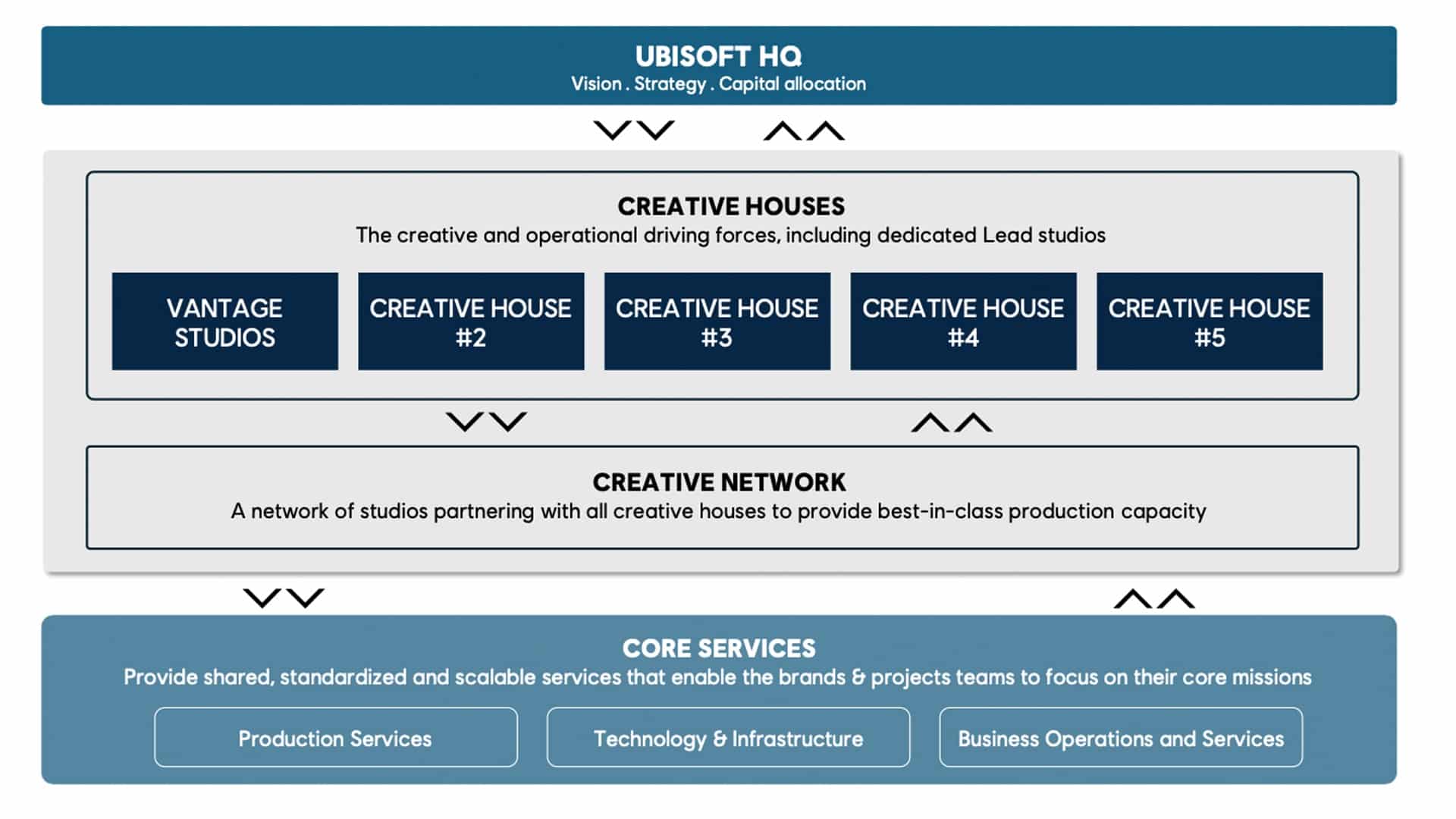
Key message no. 3: At the heart of this transformation are our Creative Houses, integrated business units that now combine production and publishing, thereby unifying the relationship with players. Each of these is focused on a clear genre and brand, has full responsibility and financial autonomy, and is led by dedicated management teams.
In plain language, this means that all studios working under Ubisoft will be restructured and sorted into so-called “Creative Houses.” This is what the future of Ubisoft looks like:
- Vantage Studios: The division, which was created thanks to billions from Tencent, will continue to exist and will focus on the economic spearheads Assassin’s Creed, Far Cry, and Rainbow Six as planned.
- Creative House 2: Focus on competitive (co-op) shooters, including brands such as Ghost Recon, Splinter Cell, and The Division.
- Creative House 3: Will focus on
select, intense live experiences
, such as Brawhalla, For Honor, Riders Republic, Skull and Bones, and The Crew.
- Creative House 4: Dedicated entirely to
immersive fantasy worlds
andnarrative-driven universes
, which according to Ubisoft include Anno, Beyond Good and Evil, Might and Magic, Prince of Persia, and Rayman.
- Creative House 5: Focuses on family-friendly casual games such as Just Dance, UNO, Hungry Shark, Invincible: Guarding The Globe, and licensed Hasbro titles.
The future: Games-as-a-Service and generative AI
Key message #4: Today’s announcement introduces […] a more gamer-focused organization that is oriented toward creative genres and based on […] a greater ability to quickly adapt to player expectations. […]
The new operating model will […] focus on open-world adventures and GaaS-native experiences, supported by targeted investments, deeper specialization, and cutting-edge technology, including accelerated investments in player-centric generative AI.
Ubisoft’s new future thus places three key themes at the center of future game development:
- Large open worlds, as seen in the latest installments of the Assassin’s Creed series
- Games-as-a-service titles, i.e., continuously evolving games designed to retain players over the long term. Probably the most successful example from Ubisoft is Rainbow Six: Siege.
- The use of generative AI
The latter point comes as no surprise, given that Ubisoft only unveiled its new AI, developed specifically for games, at the end of 2025 – we’ve already had a chance to talk to it, see and hear for yourself:
What’s it all for?
In its press release, Ubisoft emphasizes above all that the massive upheavals are intended to make the group more agile and competitive. However, another important reason is hidden deep within the 7-page PDF: cost savings.
The goal of saving €100 million, which was announced last year, will be achieved a year earlier than predicted thanks to the new measures. On top of that, the steps now being taken are expected to save an additional €200 million.
The downside: Ubisoft will initially have to dig deep into its pockets again for the group restructuring and severance payments. Ubisoft’s Chief Financial Officer Frederick Duguet tells Gamesindustry.biz that the company expects to lose over €1 billion in the current 2026 financial year.
Employees who are not affected by the studio closures will also feel the impact: Ubisoft wants to relax its work-from-home policy and return to a mandatory 5-day week in the office, as was standard practice at the publisher before the start of the coronavirus pandemic.


