





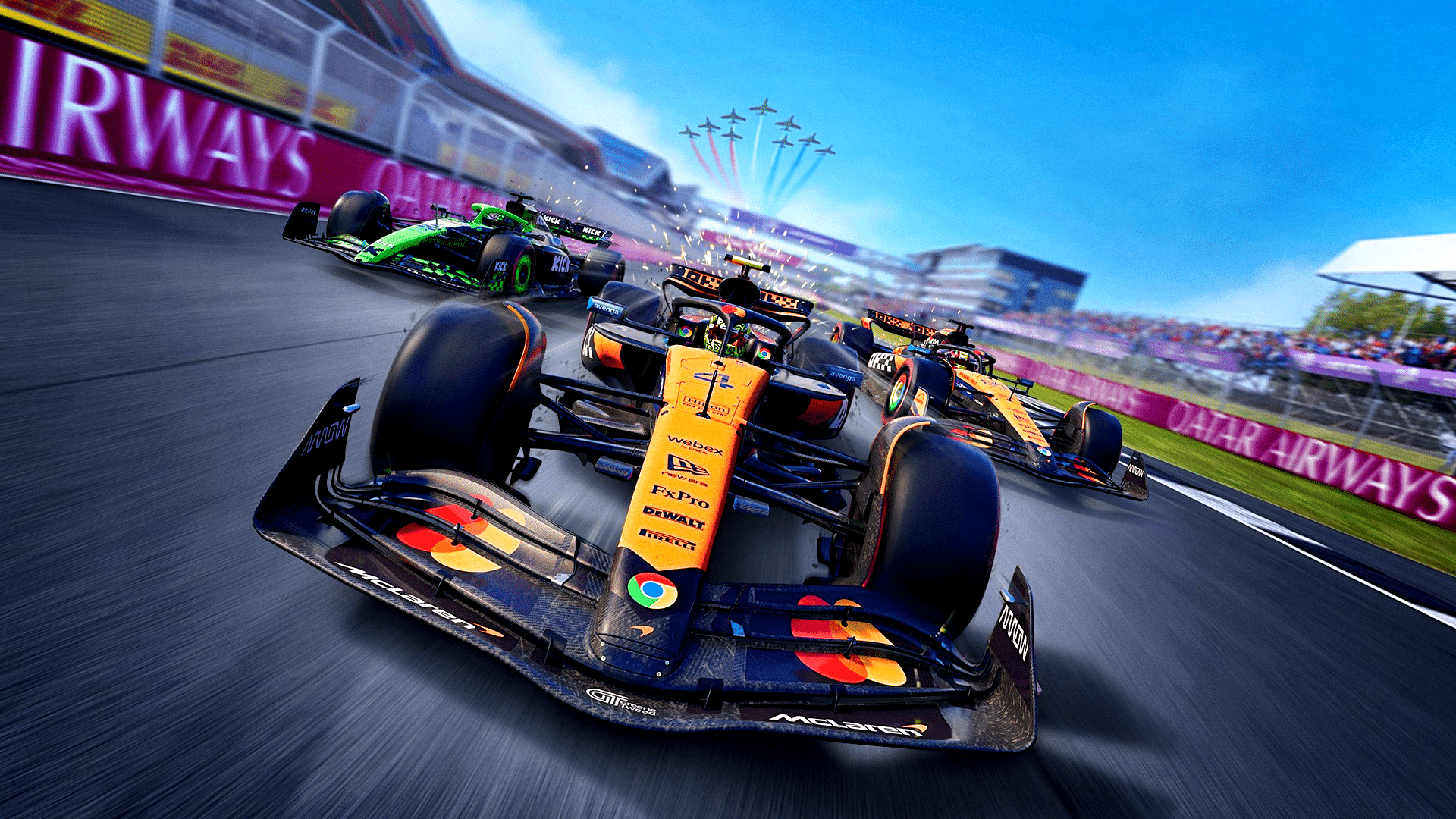
The legendary Formula 1 is learning from one of its long-standing imitators. A feature that has been an integral part of video games for decades has recently been introduced.
Every gamer is familiar with so-called ghost cars – whether from Mario Kart, Gran Turismo, Forza, or Assetto Corsa. These transparent competitors in the hunt for the best times are omnipresent in racing games.
In Formula 1 games, too, they serve as racing benchmarks in fast qualifying rounds.
Since the 2025 season, the real racing series has been using this tool to visually capture the tiny gaps of sometimes only fractions of a second on the screen.
After decades, the chance to really understand the tiny differences that set the top drivers apart is within reach for the first time.
Max Verstappen and Lewis Hamilton both enjoy sim racing in their spare time. The Dutchman from Red Bull in particular stands out as an icon of this e-sport. He even runs his own online racing team, Team Redline.
Ghosts bring the clock to life
Even in its 76th year, Formula 1 qualifying still represents the pursuit of the absolute limit. Only here do we see the maximum symbiosis of man and machine. With only the clock as their opponent, each of the current 20 (22 from next year) drivers attempts to set the fastest lap of the weekend.
But what do differences of 0.30 seconds (three tenths of a second), 0.02 seconds (two hundredths of a second) or even 0.001 seconds (one thousandth/millisecond) actually mean?
It looks clear in a table, but what would it look like on the track if both drivers started at the same time without hindering each other?
How long are…?
- 0.30 seconds is approximately how long it takes a chameleon to fully extend its tongue.
- 0.02 seconds is approximately equivalent to one wingbeat of a hummingbird. No species flutters faster, about 50 to 80 times per second.
- 0.001 seconds is 300 times faster than the average human blink (0.3 seconds).
- Typical gaps between the fastest laps in a Formula 1 field are usually well below 0.5 seconds. Of course, this also depends on the track, but a full second has always been considered an (apparent) eternity in Formula 1.
Precisely to help with this, the “ghost car” tool was introduced to Formula 1 broadcasts at the start of the 2025 season. It is designed to turn intuitively incomprehensible numerical differences into tangible stories that help shape the race weekends.
It works exactly as gamers know it from games: Parallel to the vehicle actually being followed by the onboard camera, another vehicle drives along the track. Depending on the gap, the vehicles race closer together or even literally merge into each other around the circuit in Melbourne, Abu Dhabi, Spa-Francorchamps, or anywhere else in the world.
If there is a lead, the ghost naturally remains invisible, but thanks to the close competition at the top of the field, a cat-and-mouse game usually ensues.
On the straights, the main car is literally right on the ghost car’s tail, only to then get a better entry into the corner and pull ahead. However, the advantage quickly reverses, as the transparent competitor is slightly earlier on the gas and visually escapes a few meters on the ideal line – this is how spectators experience the ghost cars.
Ghost Car reveals how insanely close the battle for pole was 🤯🍿#F1 #DutchGP @McLarenF1 pic.twitter.com/GGOmMZC8bF
— Formula 1 (@F1) August 30, 2025
Link to Twitter content
The positions always correspond to the line followed on the actual lap around the track. The sources of information are GPS data and the onboard camera(s) attached to the vehicles. The best known of these is certainly the typical perspective over the helmet, looking down slightly toward the nose of the vehicle.
Despite flood of data, manual work
With precise GPS and timing data, two cars can be superimposed in the replay, as Dean Locke, F1’s Head of Broadcast, explains in an interview with Motorsport.com:
We take the GPS data and overlay it on the video footage, tag it, and then compare it with the onboard footage. This is mostly manual work done by very good editors who are fast and pay close attention.
Although this sounds simple, there are several pitfalls that have prevented the idea from being implemented in the past. For one thing, the data was too inaccurate for a long time, and the processing took far too long for it to be of any use to Formula 1 television stations or social media teams.
After all, several days after qualifying, no one feels the need to watch such a special replay of a lap.
The hurdle was overcome thanks to new software developed specifically for Formula 1, and now it takes a maximum of two hours from the end of the fast laps. “Some of our broadcast partners say that’s fine because they can use it in their pre-shows the next day,” Locke reveals, giving an insight into the thinking behind the scenes. “But I’d like to have it faster. Our goal is 30 minutes after the end of the session.”
The reason for this ongoing process of comparison is still variance. Because:
We are very confident about the GPS positioning of the car front to back, but our left-right positioning is less reliable.
Furthermore, the camera angles are not identical from car to car: “There is a tolerance of five percent for horizontal and vertical image differences in the onboard cameras. That sounds small, but it makes a huge difference when you compare data.”
That’s why every single meter of the lap still has to be recorded manually in order to synchronize the GPS and camera images in terms of time and location. This allows the deviations in the GPS coordinates to be compensated for down to the centimeter.
However, according to Dean Locke, the data teams at the Grand Prix are constantly working on improvements, for example, to clean up signals from interference and thus provide the staff responsible for the ghost car with even higher data quality as soon as possible.
In addition, Formula 1 officials may also test AI in the near future to automate at least part of the process and thus reduce the waiting time between the finish line and the broadcast of the ghost lap.
Just a nod to video games
Meanwhile, the ghost car is by no means the only reference to video games. Ideas from gaming are now also playing a decisive role in how viewers watch the individual sessions, from practice to qualifying to the race, on TV or online.
For some time now, Formula 1 broadcasters have been displaying a game-like HUD in the middle of the viewers’ field of vision, more precisely on the halo protection ring, which forms a kind of dome over the driver’s cockpit. This conveys much more information than just speed. It also shows positions, throttle/brake, DRS status, and RPM, for example.
The difference between the visual presentation and the official game (F1 2025 by Codemasters), which is re-released every year, is becoming increasingly blurred. What would once have been considered absurd is now the standard. This is because viewers simply expect more information and more storytelling than they did in the heyday of Michael Schumacher.
Next chapter 2026 – the Formula 1 of tomorrow
Meanwhile, the next major technological revolution in Formula 1 is scheduled for 2026. With the season starting in March next year, completely new cars will be racing around the tracks – recognizable, of course, but with a number of new features both inside and out.
For example, in the engine, front and rear wings, and the car’s electronics. This will give drivers access to a time-limited boost mode. Showcasing this effectively will be the next challenge for the minds behind the stylish images.
These changes create new challenges, but they also open up fresh opportunities to play with virtual displays. Extra motivated by Apple’s F1 film, which was a hit in cinemas this year, the direction is clear:
We are already sitting in workshops to find out what data we will have and what stories we can tell from it.
With better connectivity in the car, we can show more than we are able to today.
The aim today is to appeal to both die-hard fans from past decades and a younger, broader audience. This starts with the Halo HUD and now ends with the ghost car for qualifying rounds – at least so far.
A ghost car works for everyone. Die-hard fans can see who was slightly off the ideal line, while casual fans can understand why the McLarens aren’t on pole this time.


